
How Instagram Reels Are Rebuilding 'Bombay' Inside Mumbai
From Fort to Lower Parel, a new wave of documentary-style Reels is reviving Bombay nostalgia, fueling the identity clash with Mumbai. Explore how heritage creators use Hinglish, before/after carousels, and guided walks to aestheticize the city's past.

A Walk Through Fort on Your Phone
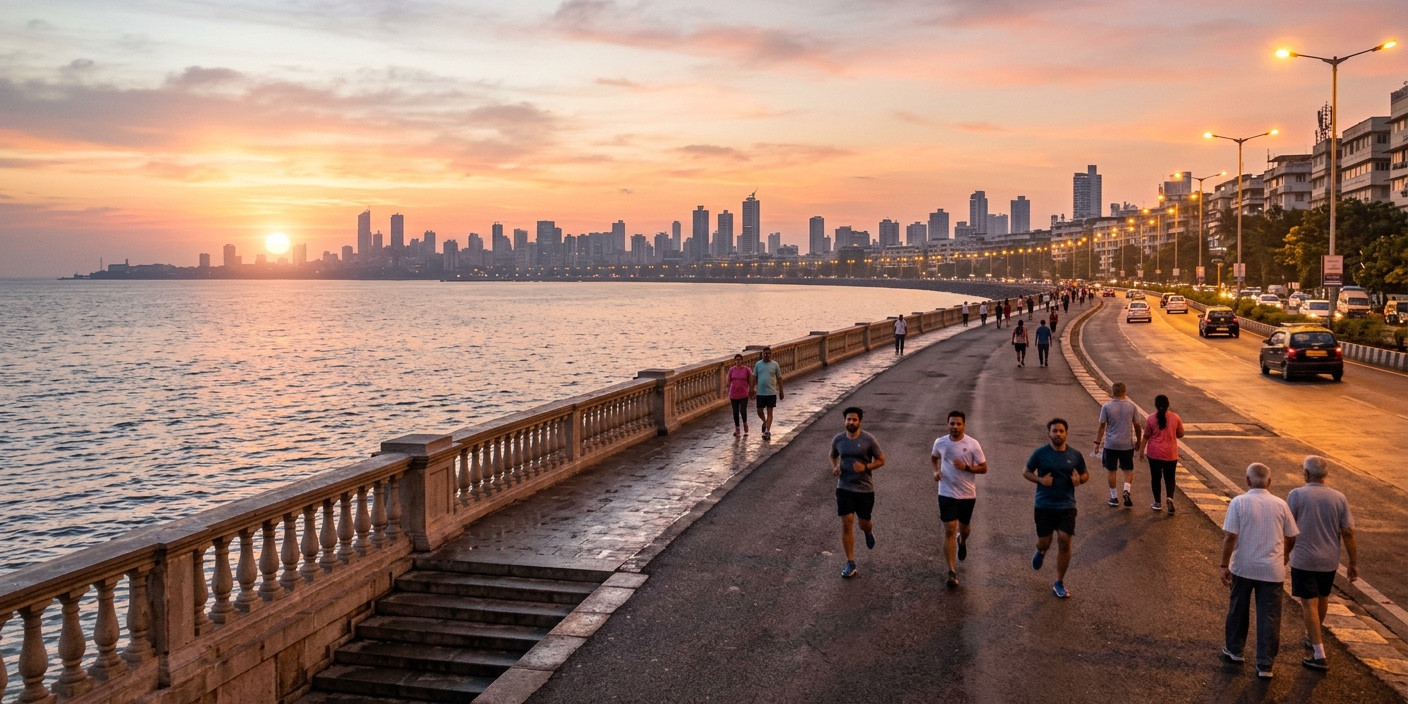
It is a golden hour in South Mumbai, and a creator’s phone pans slowly across the colonnaded facade of a 19th-century building in Fort. An archival photo fades in, overlaid with a voice speaking in Hinglish: 'Aaj tumhe dikhaungi Bombay ka ek aisa hissa jo…' The screen fills with a sepia-toned image of the same street, trams and clerks long gone, and the caption reads 'Bombay ka asli heart.' As the Reel loops, the outside world — the blaring horns, the humidity, the jostle of modern Mumbai — feels impossibly distant. This is where the article begins: not on a heritage walk, but on a screen, where a new breed of documentary-style Instagram Reels is reconstructing 'Bombay' as a mood, a memory, and a potent cultural signifier. The format is fast, vertical, and overwhelmingly visual, but its effect is slower: it invites millions of viewers to scroll through a city that may never have existed quite like this, and to feel a longing for a place they may never have experienced firsthand.
The Rise of Heritage Reels in Mumbai
Instagram Reels have become the default discovery engine for young urban Indians. The platform’s algorithm pushes Reels aggressively into Explore and non-followers’ feeds, giving short videos disproportionate reach compared to static posts. Cultural organisations and history storytellers are being told to “go all in” on Reels because they are the most effective way to showcase architecture, archives, and stories to audiences who rarely visit museums or read long-form history. In Mumbai, this has produced a noticeable wave of creators who use documentary-style Reels — short, voiceover-driven, often stacked with archival photographs — to reframe the city’s historic districts. The typical format is a 30-to-90-second vertical video structured like a micro-documentary: a hook in the first few seconds, a quick narrative, a reveal or a then-vs-now comparison, and a call to action. On-screen text carries dates, names, and key facts, while the voiceover blends English and Hindi into a conversational hybrid that keeps retention high. These Reels are not vlogs; they are miniature essays, and their creators are the city’s newest historians.
Mapping Digital 'Bombay': Fort, Ballard Estate, Parsi Baugs, and the Mill Lands
Each location these creators choose does double duty: it is a physical heritage zone and a digital backdrop for a curated 'Bombay' identity. The Fort area, around Horniman Circle and Kala Ghoda, is a prime subject. Reels walk along colonnaded streets, film neo-classical and Gothic facades, and overlay archive shots of tram lines and 19th-century street scenes. The narrative positions Fort as the 'original' downtown Bombay, a nerve centre of trade and finance before Nariman Point and BKC, implicitly contrasting it with the generic glass towers of contemporary Mumbai. Ballard Estate, with its Edwardian buildings and near-empty weekend streets, becomes a favourite for early-morning walking tours. POV shots of cycling or strolling are often set to retro Hindi film songs, and creators frame the enclave as 'stuck in time' — ideal for before/after carousels where a sepia image of the 1920s slides into a modern shot. Parsi baugs appear as quiet, green enclaves that many non-Parsi viewers have never entered, adding to their allure. Reels captured from within the baugs share anecdotal stories about community life, food, and daily rituals, contrasting the calm interior with the noisy Mumbai streets just outside the gates. And then there are the Lower Parel mill lands, once the heart of textile-manufacturing Bombay. Here, Reels pan across chimneys, brick sheds, and old machinery remnants embedded in glossy malls and office parks. Archival photos of striking mill workers are juxtaposed with footage of upscale bars and shopping arcades, telling a story of transformation from working-class industrial district to high-rent entertainment and corporate zone.
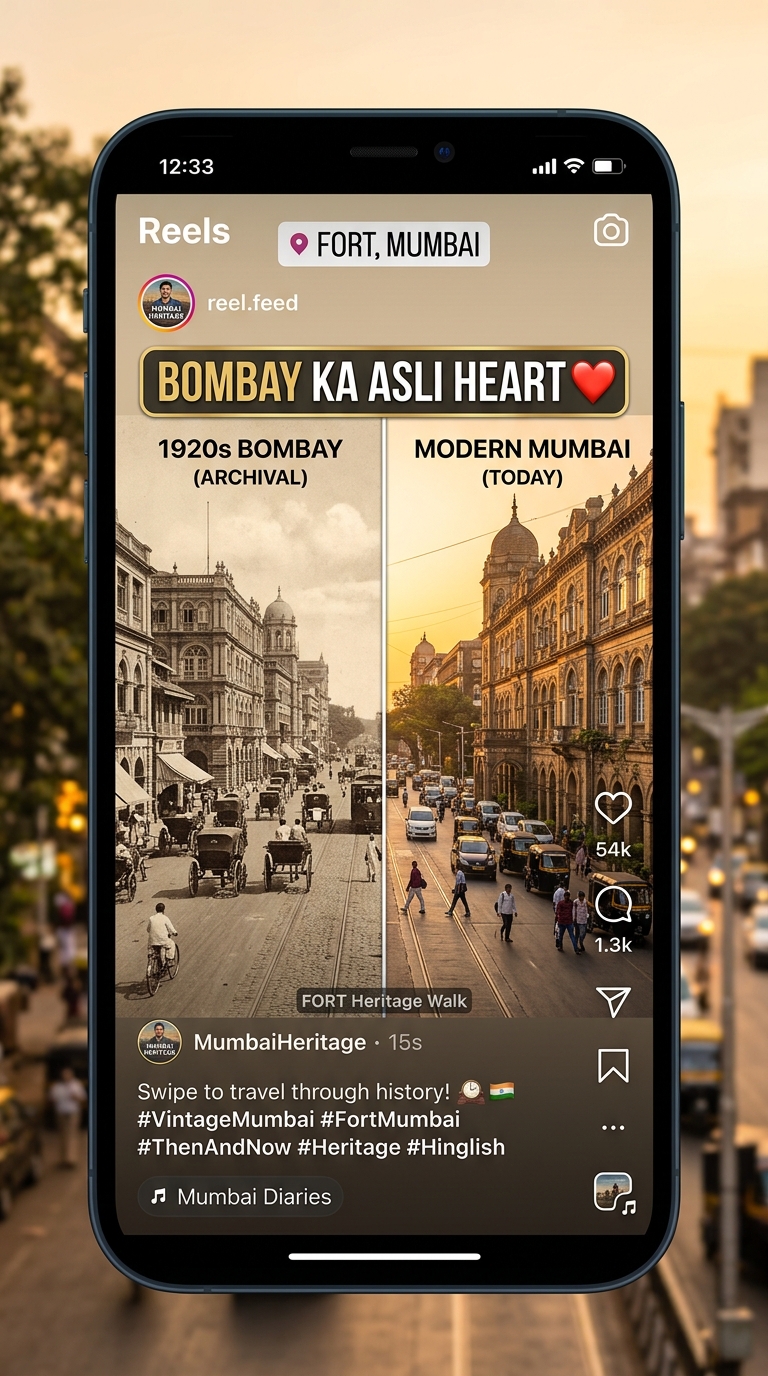
A before/after carousel Reel comparing a 1920s street in Fort with its modern-day appearance, a hallmark of the heritage Reels genre.
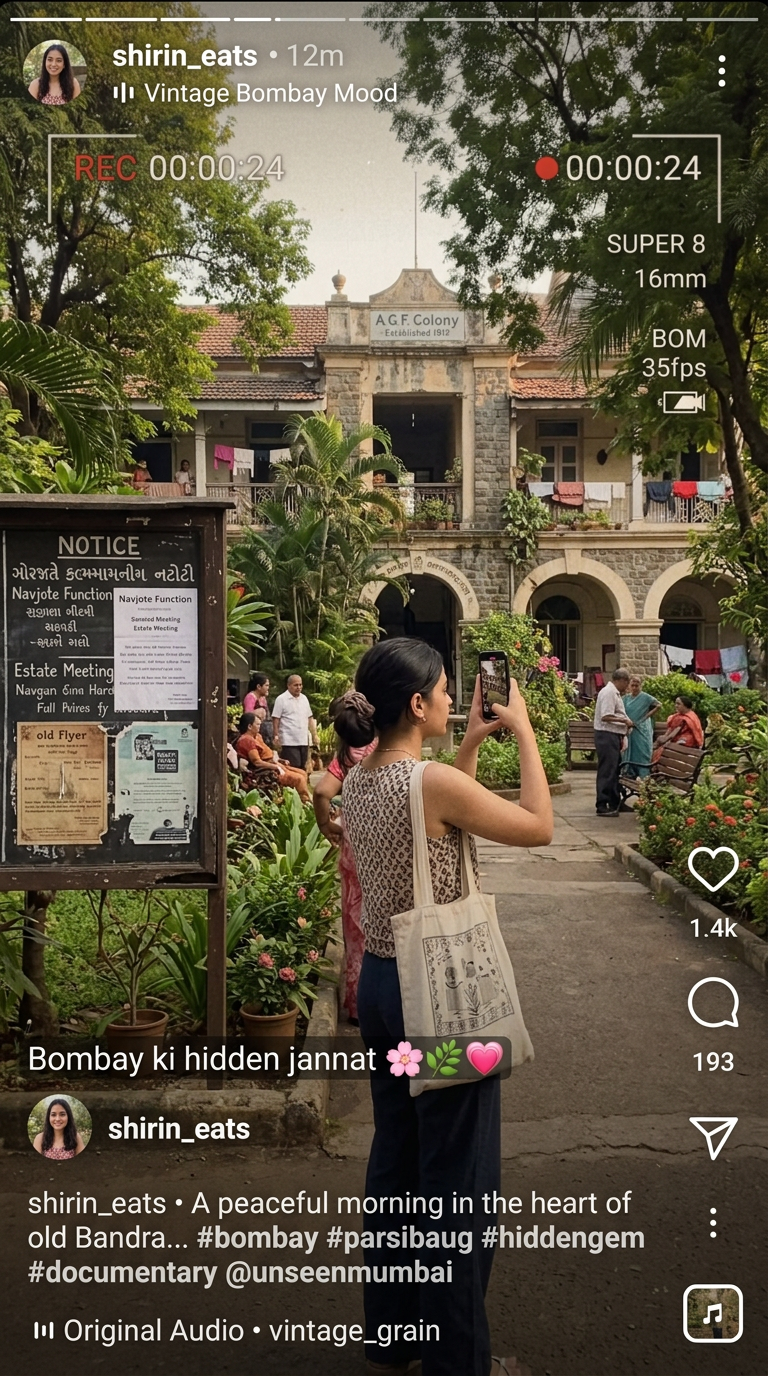
A heritage Reel shot inside a Parsi baug, highlighting the contrast between the calm enclave and the chaotic city outside.
Hinglish Nostalgia and the Bombay vs Mumbai Fault Line
Language is central to how these creators construct 'Bombay' as distinct from 'Mumbai.' Most narration and captions blend Hindi and English, with urban slang and Mumbai tapori phrases sprinkled in, making the content feel accessible and intimate. Hooks like 'Ye jo building hai na, isne Bombay ka pura scene badal diya' or 'Bombay ki asli jaan yahin hai' position heritage spaces as emotionally charged, not just visually interesting. The tone is nostalgic, slightly wistful, and deeply selective. Creators foreground Irani cafes, old bookshops, Art Deco cinema halls, and cast-iron railings, while the messier aspects of the city — slums, overcrowding, pollution — are pushed to the periphery. Soundtrack choices amplify this effect: classic Hindi film songs, RD Burman tracks, Lata Mangeshkar numbers evoke a pre-2000s cinematic Bombay. The official name of the city has been Mumbai since 1995, a change driven by regionalist politics and appeals to Marathi identity. Yet 'Bombay' persists in popular culture and everyday speech, functioning as a nostalgic, cosmopolitan signifier. On Instagram, this historical residue is being repackaged into a brand. Reels present a mythic, timeless 'Bombay' that is mostly South Mumbai and older middle-class neighbourhoods, refined, cultured, walkable, and café-laden. It is a geography built not from municipal boundaries but from a moodboard.
Gentrification and the Heritage Economy
Heritage Reels in Mumbai do not simply document the city; they participate in its transformation. The Lower Parel mill lands are the emblematic case. Once a zone of textile mills, workers' housing, and powerful unions, the area is now dominated by luxury malls, office parks, and high-end residential towers. Reels linger on surviving chimneys and brick walls as 'Instagrammable ruins,' but the workers' histories are often compressed into a few caption lines, if they appear at all. This aligns with global critiques of 'heritage-washing': preserving selective fragments of the past as décor while the underlying social and economic displacements go unexamined. Heritage walks, heavily promoted through Reels, embody a similar ambivalence. On one hand, they popularise local history, drive footfall to old businesses, and may help build a preservationist constituency. On the other, they risk turning lived neighbourhoods into consumable experiences for outsiders and may accelerate commercial interest and rising rents in 'discovered' areas. The Reels that market these walks, often framed in aspirational Hinglish, democratise history but also commodify it. Critical questions arise: whose stories get told? Are the Reels more likely to centre architects, planners, and café owners rather than tenants, shop assistants, or former mill workers? Do Parsi baugs appear as charming enclaves rather than sites of demographic decline and community anxieties? There is a quiet politics in what is framed, and what is left out of the frame.
Meanwhile on r/mumbai: Arguing the City
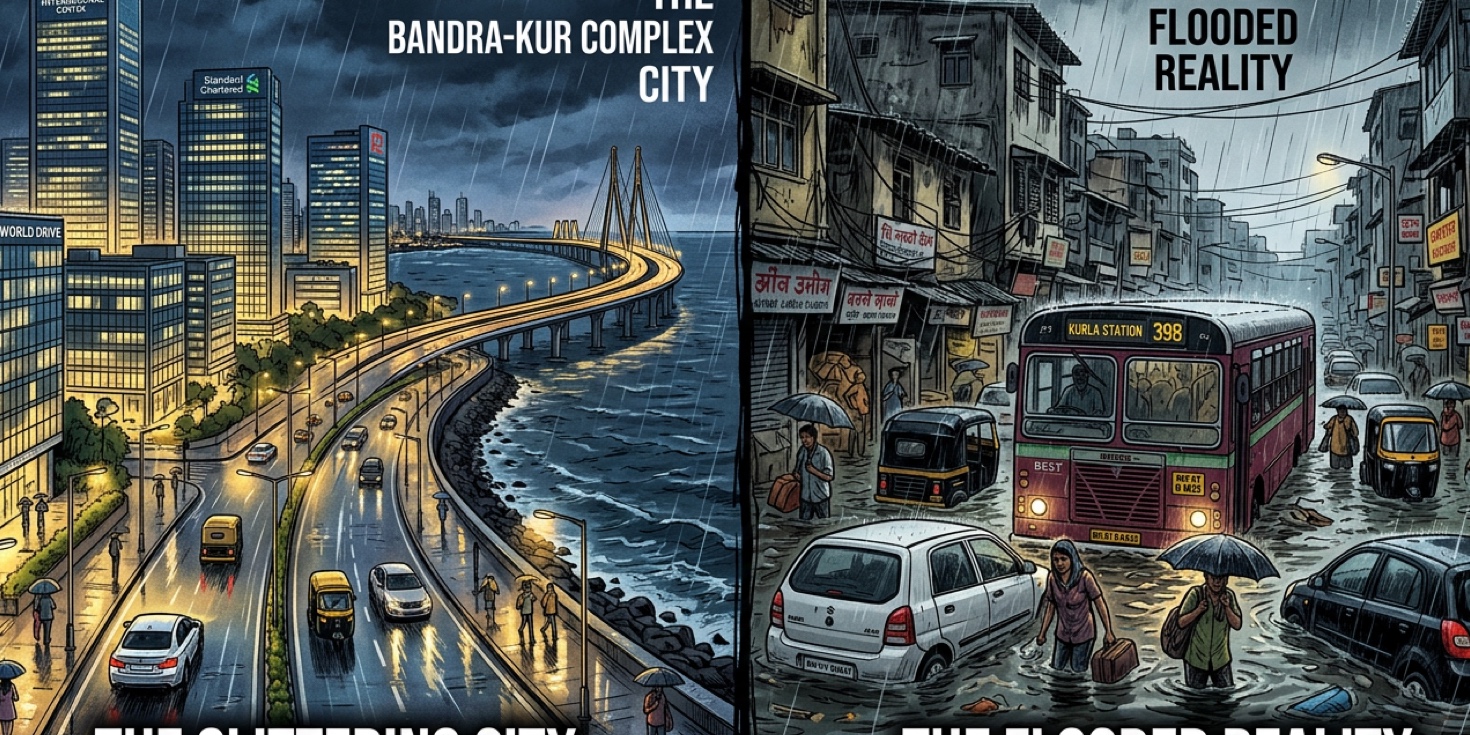
If Instagram aestheticises the city, Reddit argues about it. On r/mumbai, the conversation is text-heavy, discursive, and problem-focused. Posts about rent, overcrowded trains, waterlogging, civic corruption, and everyday survival sit alongside occasional nostalgia threads. Users share old photos of Bombay, ask 'What do you miss about the old city?', and debate the politics of the name change. But the dominant mode is argument and storytelling in text, not cinematic visual curation. The tone is more explicitly political, with discussions about linguistic tensions, real-estate speculation, and which communities feel pushed out of the city’s core. Here, nostalgia is not a moodboard but a contested field. A thread about the beauty of Fort might immediately be countered by comments on the lack of public toilets or the cost of a cup of chai. The two platforms thus represent different publics negotiating the same urban identity. Instagram produces 'Bombay' as a brand; Reddit deals with 'Mumbai' as a lived, often frustrating, reality. The gap between them is not just a matter of format but of what each platform rewards: aspiration versus confrontation, aesthetics versus accountability.
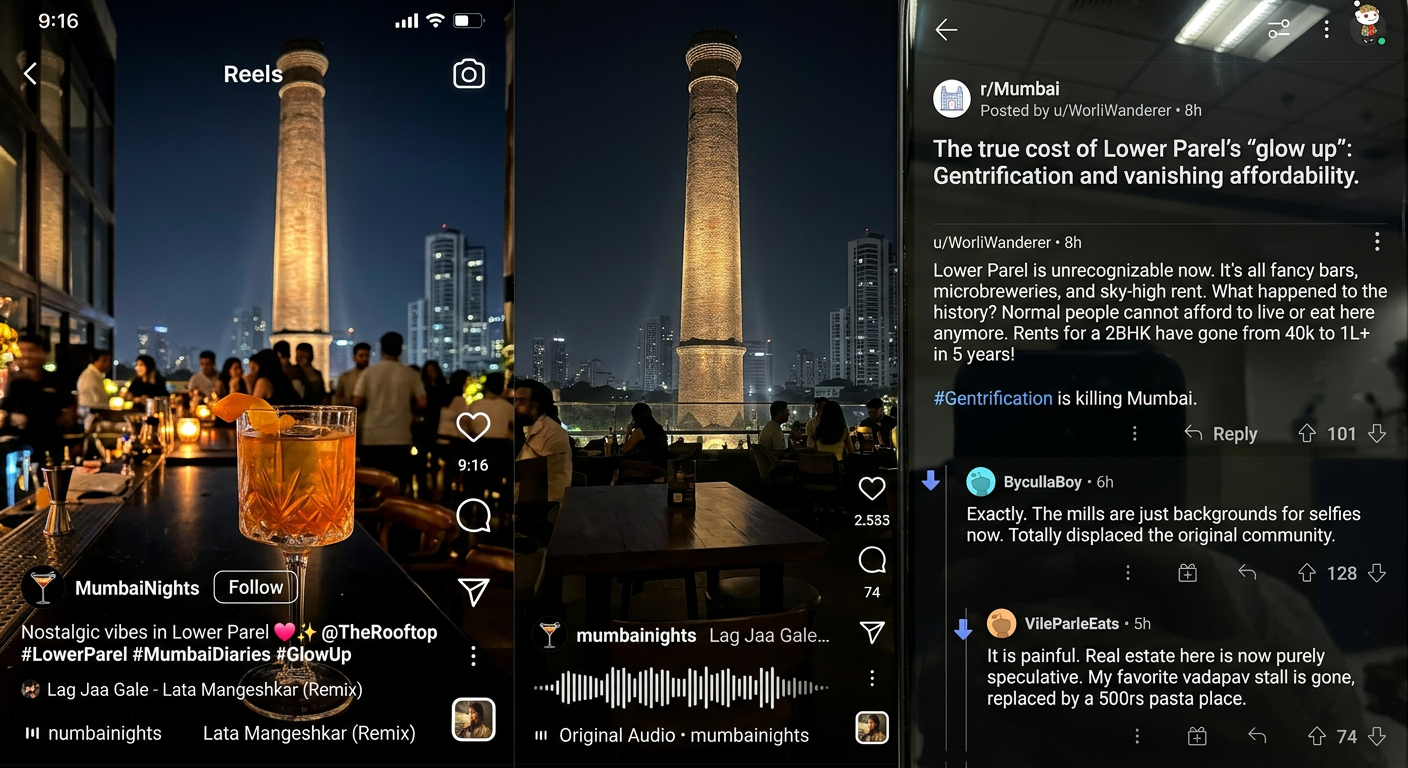
The two faces of digital urban identity: Instagram's aestheticized 'Bombay' and Reddit's argumentative 'Mumbai' side by side.
Content Formats: Micro-Documentaries, Guided Walks, and Before/After Carousels
The creators working in this space have developed a distinct set of formats that map onto broader Reels best practices. The micro-documentary Reel is the flagship. It typically opens with a striking hook — a question on screen like 'Did you know Bombay once had its own Wall Street?' — then cuts to walking footage in Fort while a voiceover explains the area’s original purpose and its colonial origins. A before/after photo provides the reveal, and the reel ends with a gentle reflection on what has changed, followed by a call to action: 'Save this for your Fort itinerary' or 'Comment if you remember this spot as a kid.' Guided-walk Reels serve a dual purpose, documenting the experience while marketing the tour itself. Creators film segments of their walks, showing participants listening to stories or photographing hidden details, and they tease more stories available on the paid walk. Carousels, often paired with Reels, provide slower, savable content. A typical carousel might open with a dramatic archival photograph — a mill in full operation, an old tram in Fort — and then slide through the creator’s contemporary shots from the same angle. The caption becomes a short essay in Hinglish explaining the shift from mills to malls, or from ports to offices. Together, these formats create an ecosystem where the past is constantly being remixed, saved, and shared, building a digital archive that is as much about emotion as it is about information.
The Future of Digital Bombay
The question remains whether this Instagrammed 'Bombay' can drive preservation, tourism, or policy attention, or whether it will simply become another aesthetic trend. The Reels have undoubtedly brought histories to new audiences, including the diaspora, and have made the city’s architectural heritage feel urgent and in need of protection. But the platform is fickle, and the Reels that go viral today may be forgotten tomorrow. There is also the issue of archiving: when these creators leave Instagram or the platform changes, what happens to the digital stories they have told? The contrast between the glossy heritage Reels and the messy, argumentative threads on r/mumbai suggests that the identity of the city is being negotiated in multiple arenas, each with its own biases. One can imagine a future scene: a creator filming a Reel during a guided walk in Fort, while a Reddit thread simultaneously complains about noise or crowds in the same neighbourhood. The two coexist, and the tension between them is the story of the city itself — forever caught between what it was, what it is, and what it is being made to be.
Sources
15 History & Historical Facts Reels Ideas That Go Viral (2026)
Instagram Reels Strategy for Ancient Civilizations Creators (2026)
Culture Instagram reel | Instantly Create a Culture Instagram reel | Design.com
Create Viral Instagram Documentary Reels in After Effects | Full Tutorial
After Effects Tutorial: Create Viral Instagram Documentary Reels (2025)
How do I create high-quality "Documentary Style" Shorts - Reddit
20 Instagram Reel ideas for all types of brands - Sprout Social
This LONGEST FREE AI Video Generator Creates Long YouTube Videos, Documentaries & Instagram Reels
1,754 Reel Instagram Stock Video Footage - 4K and HD Video Clips | Shutterstock
Egyptian History Video Reels | Ancient Egypt Short-form Clips - Etsy