
Inside Bengaluru’s AI Underground: A Field Guide to HSR’s Hacker Houses, Koramangala Meetups, and the Discords Where Founders Are Born
A hyperlocal guide to Bengaluru’s AI-native startup scene. Explore HSR Layout garages, Koramangala workspaces, Discord servers, and weekly build-in-public meetups where indie developers find co-founders.
An Evening in HSR Layout: The New Ground Zero
Walk down a quiet street in Bengaluru’s HSR Layout on a weekday evening, and the scene is deceptively calm. Inside a single unremarkable building, however, the future of Indian AI is being coded. Local lore now celebrates one Urban Vault structure that houses five distinct AI startups stacked floor by floor: Loop AI on the ground, Factors AI on the first, Raga AI on the second, Frinks AI on the third, and Actyv AI on the fourth. This concentration, widely dubbed a ‘Peak Bengaluru’ moment and the ‘AI land of India’ on social media, captures the intense clustering of early-stage AI activity in a few dense blocks. A couple of indie developers, fresh from a nearby meetup, debrief over filter coffee at a corner café, debating the merits of fine-tuning open-source models versus prompt chaining. This is not the corporate glass-tower India of popular imagination. This is the AI underground—a gritty, accessible, and deeply networked world where the primary currency is shipping code.
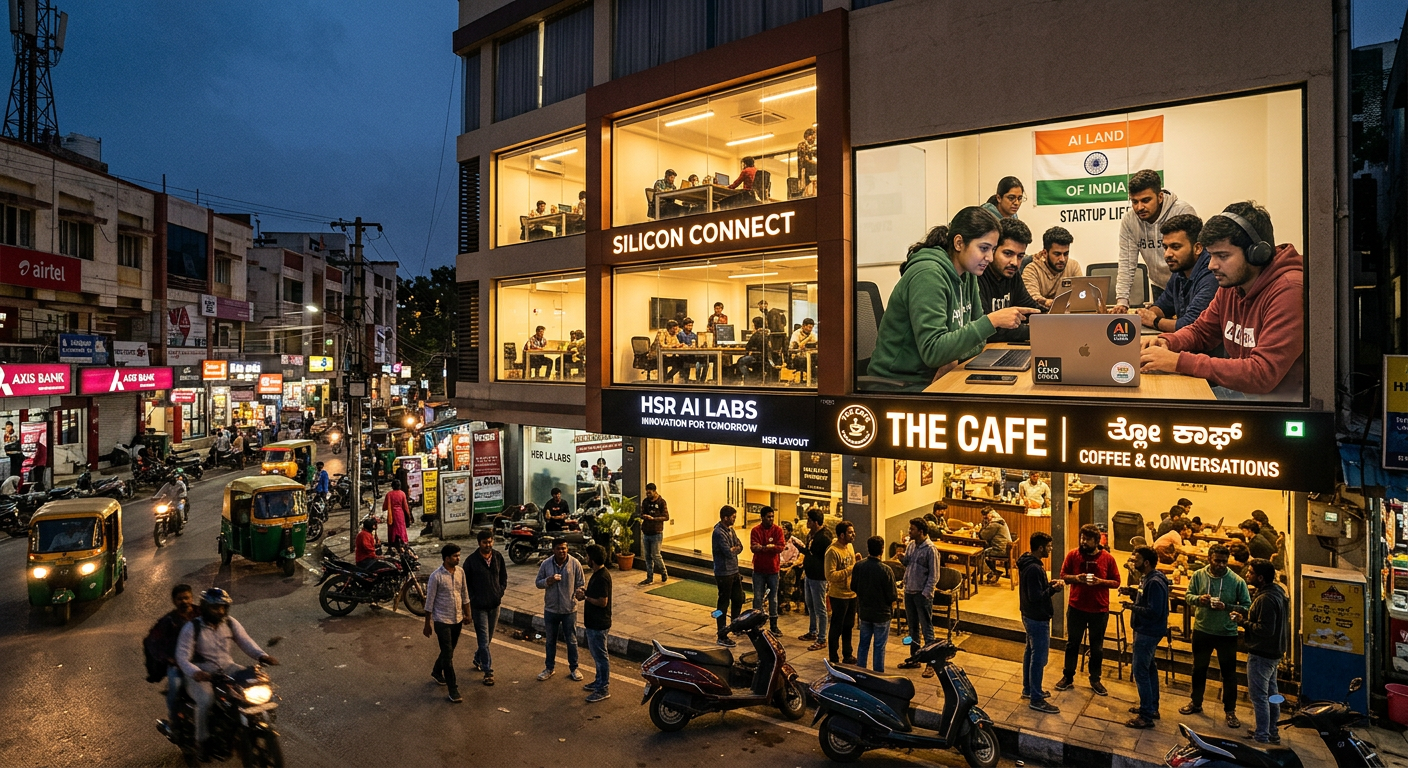
The unassuming streets of HSR Layout, where a single building can house five AI startups and serve as the gravitational center for Bengaluru’s indie developer community.
Why Bengaluru Commands India’s AI Future
Bengaluru has cemented its status as India’s de facto AI capital, with ecosystem analyses pointing to over 1,000 AI startups operating within the city. Multiple reports position the city as the clear leader in the national AI startup race, outpacing other hubs like Delhi-NCR and Mumbai in both company density and talent concentration. This gravitational pull now extends globally. Major AI firms, including Anthropic and OpenAI, have chosen Bengaluru as their primary entry point into India, a strategic decision that validates the city’s unparalleled mix of engineering depth and market opportunity. The long-term view is equally ambitious, with plans unveiled for a ‘humanity-centric AI city’ and a 500,000-square-foot ‘AI Superpark’ in the Sarjapur area. For a wannabe founder, however, the immediate action isn't in future developments or corporate parks. It is unfolding right now in garage offices, hacker houses, and weekly meetups scattered across a few key neighborhoods.
The Physical Map: HSR, Koramangala, and Their Satellites
HSR Layout functions as Bengaluru’s AI ground floor—the neighborhood you move to when you’ve decided to start something but haven’t raised a serious round. Compact, low-rise buildings are cheaply converted into garage-style offices or small coworking floors, attracting founding teams who have just left big tech jobs. Proximity to the talent pools of Bellandur, Sarjapur Road, and the Outer Ring Road tech parks ensures a steady stream of potential hires and collaborators. A short drive away, Koramangala retains its crown as the classic startup neighborhood. Historically home to Flipkart’s early offices, it now hosts seed-stage to Series A AI startups, early-stage venture funds, and long-running community cafés. It is the natural crossover point where technical AI founders meet business-heavy co-founders and where global accelerators hold closed-door founder dinners. Meanwhile, central hubs like MG Road and Indiranagar host time-bound pop-up programs, such as the AWS Gen AI Loft at Trinity Circle, which offered free coworking, technical mentoring, and workshops for GenAI developers. Further north, near the M.S. Ramaiah campus, spaces like ThinkTech Space explicitly brand themselves as AI-native builder ecosystems for students and early-stage founders.
Community Workspaces as Social Routers
Beyond generic desks and Wi-Fi, specialized coworking spaces act as the social routers of the AI ecosystem. ThinkTech Space, positioned opposite the MSRIT campus, provides a ‘builder’ environment specifically designed for college-age founders learning to ship AI projects quickly. In the KIADB Hi-Tech Park area, AICowrk markets itself as a dedicated AI coworking space for deep-tech startups, signaling a rise in sector-focused infrastructure. General coworking operators in HSR and Koramangala, while not explicitly AI-only, host a disproportionate number of solo technical founders and indie developers. Their event calendars, mirrored on Luma and Meetup, are filled with ‘AI Builders’ Nights,’ hack evenings on open-source LLM stacks, and ‘show your side-project’ sessions. These spaces function as semi-public living rooms. You do not need a funding announcement to walk in; often, attending a meetup or paying for a flexi desk is enough to start the conversations that lead to a founding team.
The Digital City: Discords, Telegram, and Building in Public
A parallel digital city overlays Bengaluru’s physical neighborhoods. Informal hacker houses, where young founders live and build AI tools together, have become legendary. One viral video captures a ‘secret Bangalore hacker house’ where residents work off standing desks in shared rooms, shipping prototypes on short cycles. These physical spaces are deeply intertwined with online build-in-public culture. Founders actively share weekly updates, screenshots, and revenue milestones on X and LinkedIn, creating a digital persona that precedes them. City-focused Discord servers and Telegram groups—often labeled ‘Bangalore Startups’ or ‘India Indie Hackers’—buzz with channels dedicated to co-founder matching, event link sharing, and landing page teardowns. Tech stack-specific communities around open-source LLM frameworks also feature local chapters where ad-hoc meetups are spontaneously organized. For a newcomer, this means the offline world is rarely discovered purely offline; there is almost always a Discord or Telegram link that serves as the gateway.
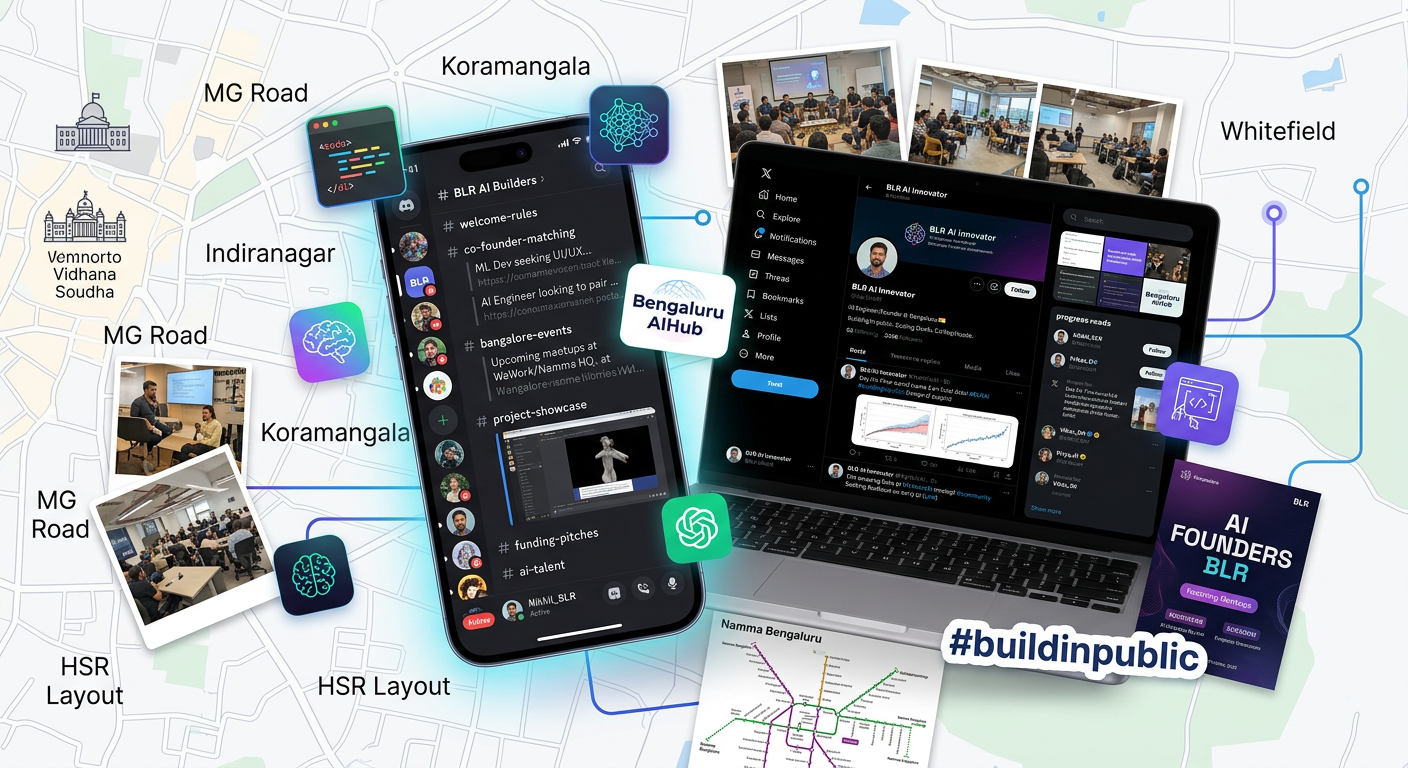
The parallel digital city: Discord servers, Telegram groups, and build-in-public threads on X form the connective tissue between Bengaluru’s physical meetups and hacker houses.
Recurring Meetups: How to Find Your Tribe
The weekly rhythm of Bengaluru’s AI scene is best tracked on Luma, Meetup, and Eventbrite, where recurring archetypes dominate the listings. For hardcore technical practitioners, PyData Bangalore hosts talks and workshops on MLOps and model deployment, often in HSR and Koramangala tech offices. TensorFlow User Group (TFUG) Bangalore runs study jams and hands-on sessions for deep learning practitioners. On the product and indie hacking side, ‘Indie Hackers Bangalore’ and ‘Bootstrapped SaaS Bangalore’ meetups feature show-and-tell demos and live teardowns of onboarding flows. A growing ‘Build in Public Bengaluru’ circuit sees founders giving five-minute demos, with X handles shared as prominently as company names. No-code and automation circles, searchable under ‘No-Code Bangalore’ or ‘FlutterFlow Bangalore,’ attract non-traditional coders building AI-powered micro-SaaS tools. For student founders, campus-linked hackathons and demo days for college bootcamps appear frequently, often co-hosted by engineering colleges and fellowship programs, providing a direct line to angels scouting young talent.
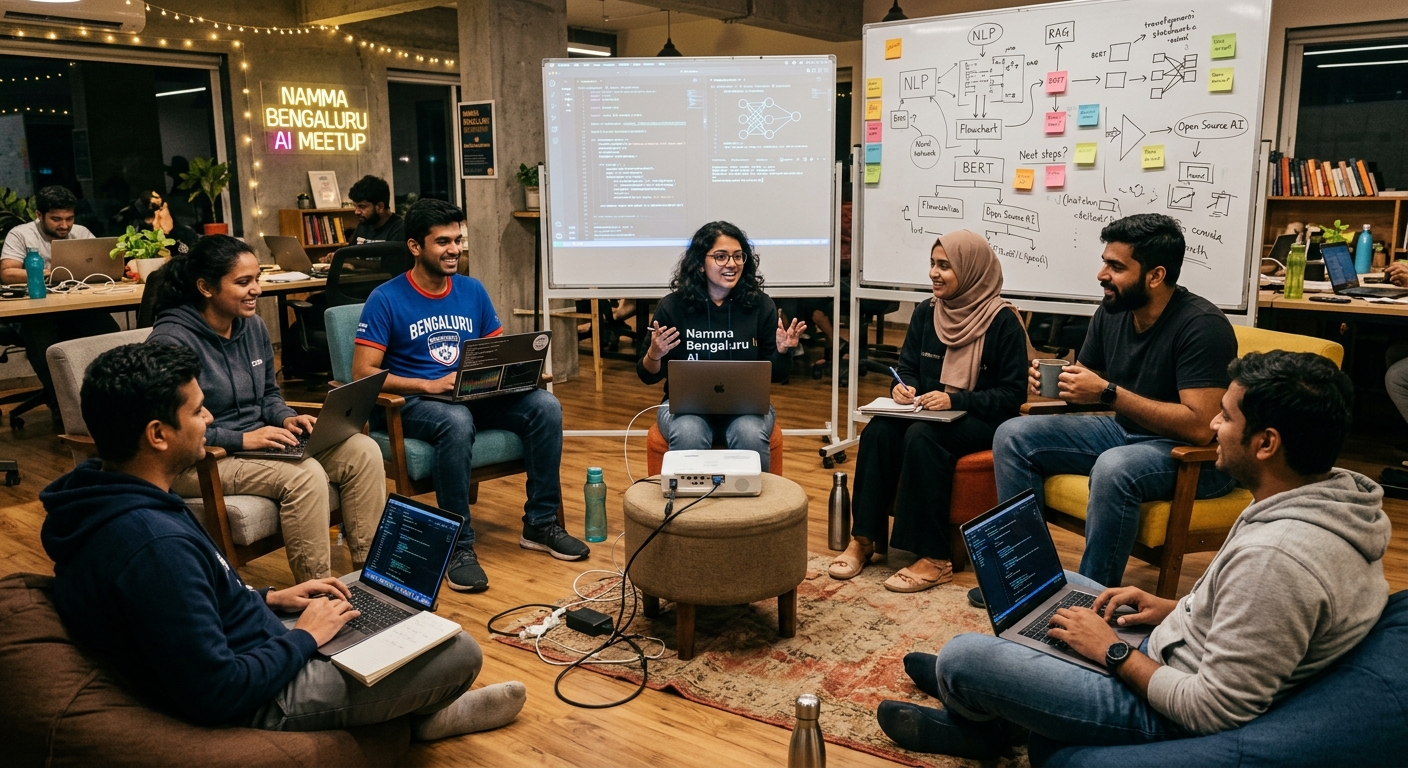
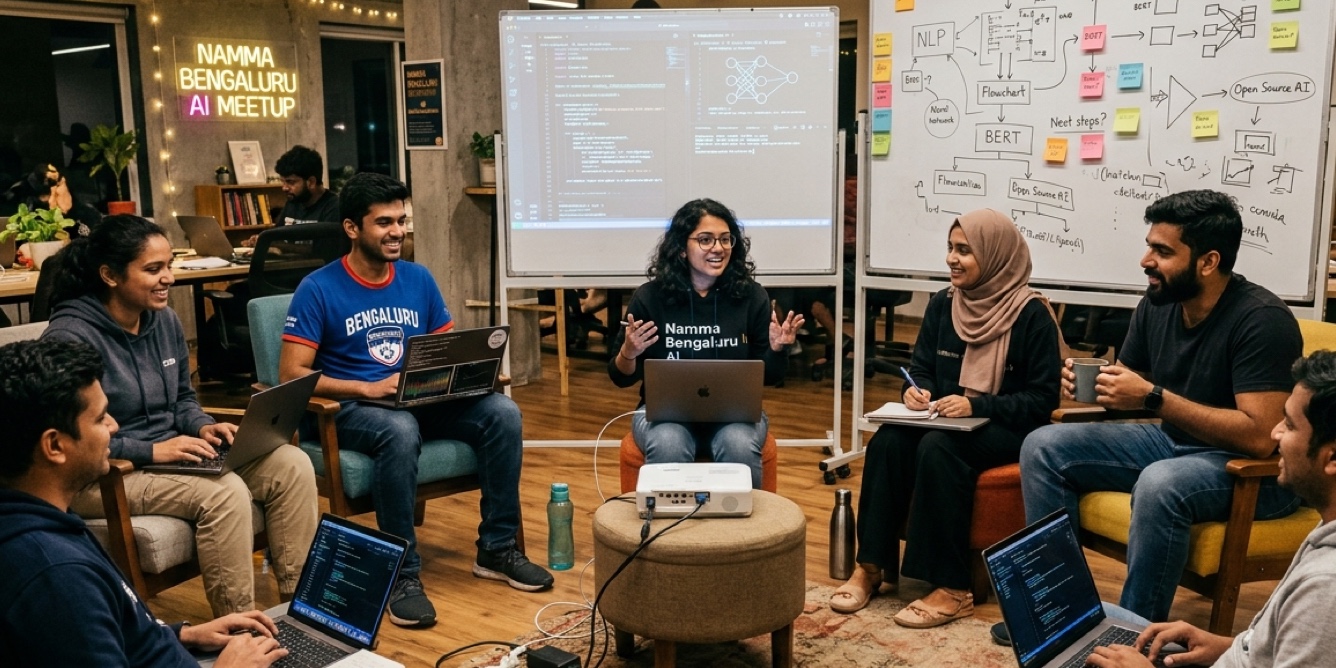
A typical 'AI Builders' Night' in a Koramangala or HSR coworking space, where shipping a prototype matters more than a polished pitch deck.
How Co-Founders Are Actually Found
Co-founder formation in this ecosystem is rarely a single eureka moment. It is a function of repeated, low-stakes collisions. Regulars at a PyData or TensorFlow meetup might start a Kaggle competition together, an effort that slowly evolves into a product. Coworking neighbors in an HSR shared office naturally spot complementary skills: an indie dev building a prototype is only a desk away from a sales-savvy operator who starts helping informally. Hacker house residents often become co-founders after surviving a 48-hour hackathon together, having observed who actually ships under pressure. The online layer accelerates this. A ‘build in public’ progress thread on X acts as a magnet, attracting engineers who resonate with a specific tech stack or operators who see a market gap being addressed. Many co-founder discussions start in DMs and quickly move to coffee in Koramangala or a whiteboard session in a coworking breakout room. The practical playbook for a wannabe founder is to pick one core space and one meetup series, show up consistently for three months, and volunteer to give a lightning talk.
Angels, Bootcamps, and the Next Generation
The grassroots ecosystem is amplified by angel networks and a new wave of student-focused bootcamps. Angel syndicates and micro-angel collectives, often composed of exited founders, organize ‘AI demo nights’ and ‘pitch & pizza’ sessions in Koramangala and HSR. These groups blur the line between investor and peer, frequently hanging out at the same coworking spaces and meetups as the founders they might fund. Simultaneously, technical AI bootcamps and founder-focused fellowships are normalizing college-age entrepreneurship. Programs teaching LLM engineering or full-stack AI development run offline project days and hackathons in Bengaluru, culminating in demo nights where local angels and pre-seed funds are explicitly invited. This creates a structured pipeline from GitHub project to funded startup, feeding alumni directly into the city’s angel networks and reinforcing the idea that starting up during college is a serious, supported path.
How to Plug In This Weekend
The barrier to entry into Bengaluru’s AI-native scene is low, but the expectation to ship is high. Start by choosing a physical anchor: explore a flexi-desk in an HSR coworking space or attend a student-focused hub like ThinkTech Space if you are a recent graduate. Open Luma or Meetup and search for ‘PyData Bangalore,’ ‘Indie Hackers Bangalore,’ or ‘No-Code Bangalore’ to find two events happening in the next ten days. Before you walk in, post your first build-in-public thread on X or LinkedIn—share a small project, a learning in progress, or a problem you are exploring. Join one city-focused Discord server and introduce yourself in the local channel. The goal is to make your online proof of work precede your physical handshake. When you arrive at the meetup, you won't be a stranger; you will be the person whose handle people already recognize, turning a cold room into a warm introduction zone where co-founders, collaborators, and early users are waiting.
Sources
ThinkTech Space | AI-Native Coworking & Startup Hub near MSRIT ...
बंगळुरूमध्ये उभारले जाणार जगातील पहिले AI शहर; AI Summit ...
Five AI startups in one HSR building make for a 'Peak Bengaluru ...
Why AI firms such as Anthropic and OpenAI are choosing Bengaluru as their entry point into India
Inside this secret Bangalore hacker house — young founders ...
Bengaluru emerges as India's AI hub, with over 1000 startups
Bharat1.AI unveils plan to build humanity-centric AI city In Bengaluru