
Beyond Indiranagar: How Breweries Are Redrawing Bengaluru’s Nightlife Map
Major bar and brewery brands are expanding into Hebbal, New BEL Road, Yeshwanthpur, and JP Nagar, signaling a shift from central nightlife to self-sufficient live-work-play ecosystems around tech corridors and new malls.

A Friday Night in Hebbal, Not Indiranagar
It’s 8 p.m. on a Friday, and the crowd at Lucky Chan in Hebbal is three-deep at the bar. Groups of young professionals fresh from nearby Manyata Tech Park are sharing dim sum baskets and clinking cocktail glasses, while families from the new high-rises along Thanisandra Road settle into corner tables. A few kilometers away, at Phoenix Mall of Asia, a multiplex crowd spills out and merges with the queue at a craft brewery. This isn’t the Bengaluru nightlife of old—the Church Street crawl or the Indiranagar 100-ft Road brewpub hop. It’s a scene unfolding in a neighborhood that, until recently, was better known as a traffic junction than a dining destination. The city’s social gravity is shifting, and the breweries are leading the way.
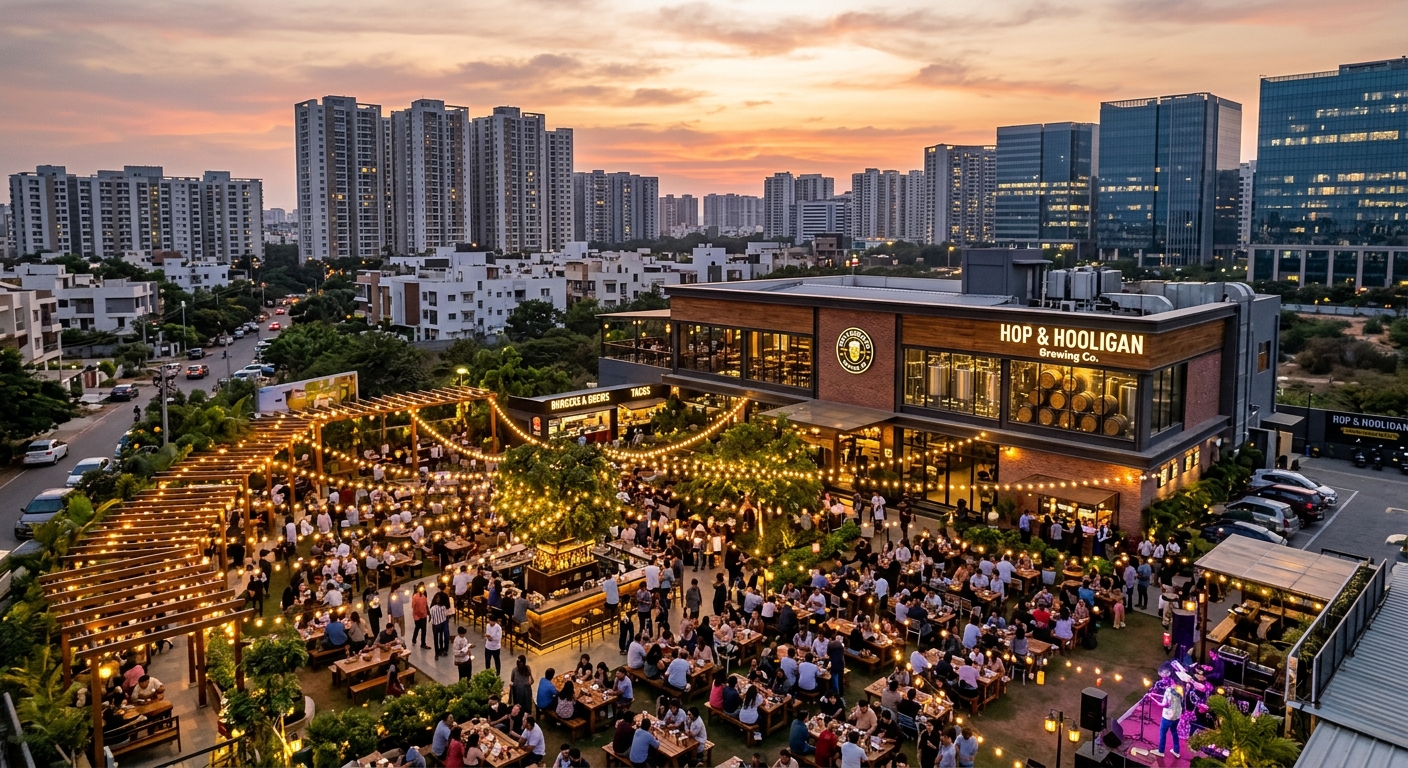
Large-format breweries like those in Hebbal and JP Nagar are anchoring new going-out districts far from the central core.
The Old Core vs. The New Map
For years, Bengaluru’s nightlife was synonymous with a central spine: MG Road, Brigade Road, Church Street, and the dense brewpub clusters of Indiranagar and Koramangala. These zones, along with early brewery outposts on Sarjapur Road and in Whitefield, formed the city’s entertainment core. But since 2024, a decisive push by major bar and brewery brands into peripheral neighborhoods has redrawn the map. New BEL Road, Hebbal, Yeshwanthpur, and the JP Nagar–ORR belt now host large-format venues that would have been unthinkable outside the center a decade ago. This is not a scattering of small cafes; it is a structural rebalancing of where the city drinks, dines, and socializes, creating a polycentric nightlife that mirrors Bengaluru’s job and housing geography.
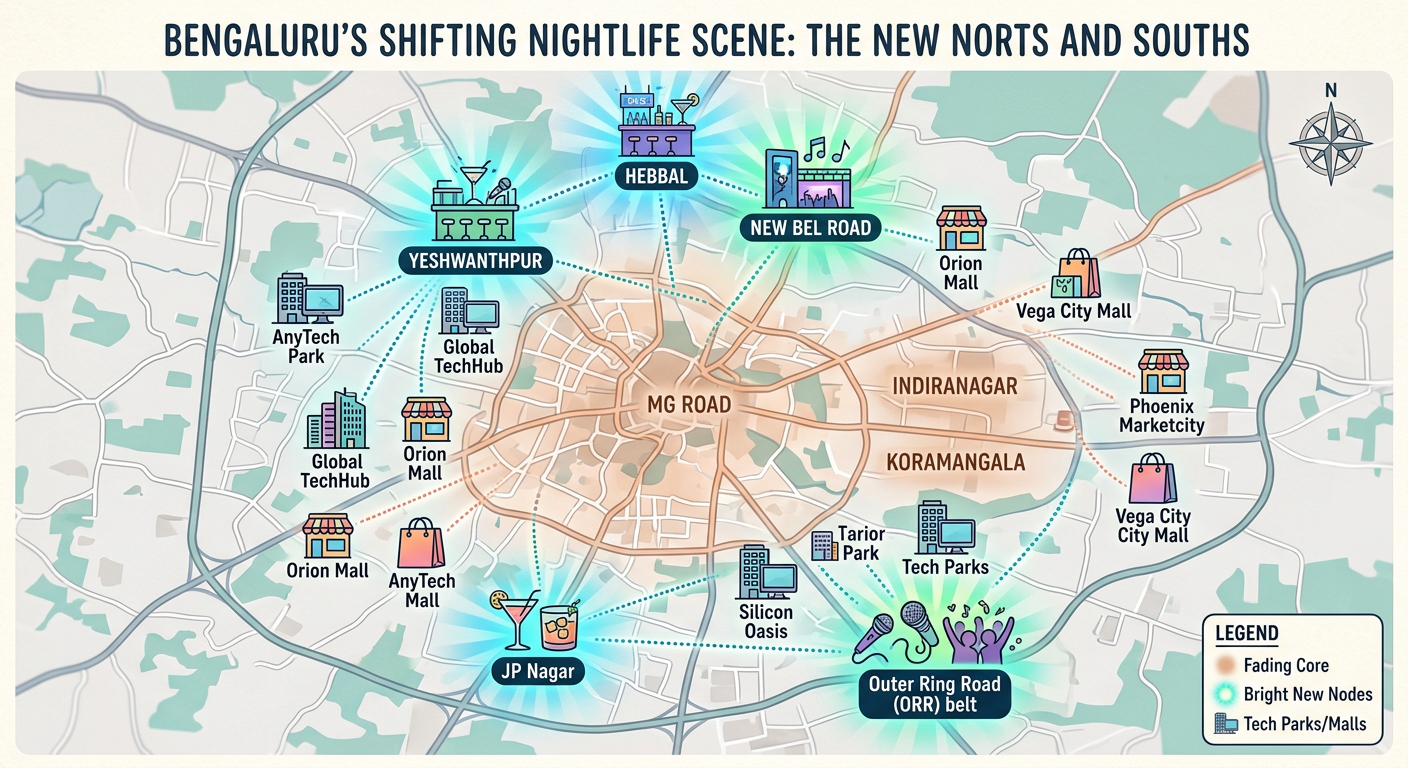
Bengaluru's social geography is becoming polycentric, with new brewery clusters mapped directly onto job and housing corridors.
North Rising: Hebbal, New BEL Road, and the Mall-Tech Ecosystem
The northern arc is the most dramatic example of this transformation. In Hebbal and Nagavara, the arrival of Phoenix Mall of Asia—an experience-driven retail and entertainment complex—has been a catalyst. It sits within striking distance of Manyata Tech Park, which employs over a lakh people. The result is a self-contained going-out district where office workers can catch a movie, shop, and end the evening at a high-quality brewpub without crossing the city. ICB – Indian Craft Brewery has opened a 1,500-seater microbrewery directly in Manyata Tech Park, explicitly positioned as an after-office and weekend hub for the tech workforce. Meanwhile, New BEL Road has evolved from a student-heavy café strip into a destination for major national brands, with SOCIAL opening a work-by-day, bar-by-night outpost that brings the Indiranagar formula to the northwest.
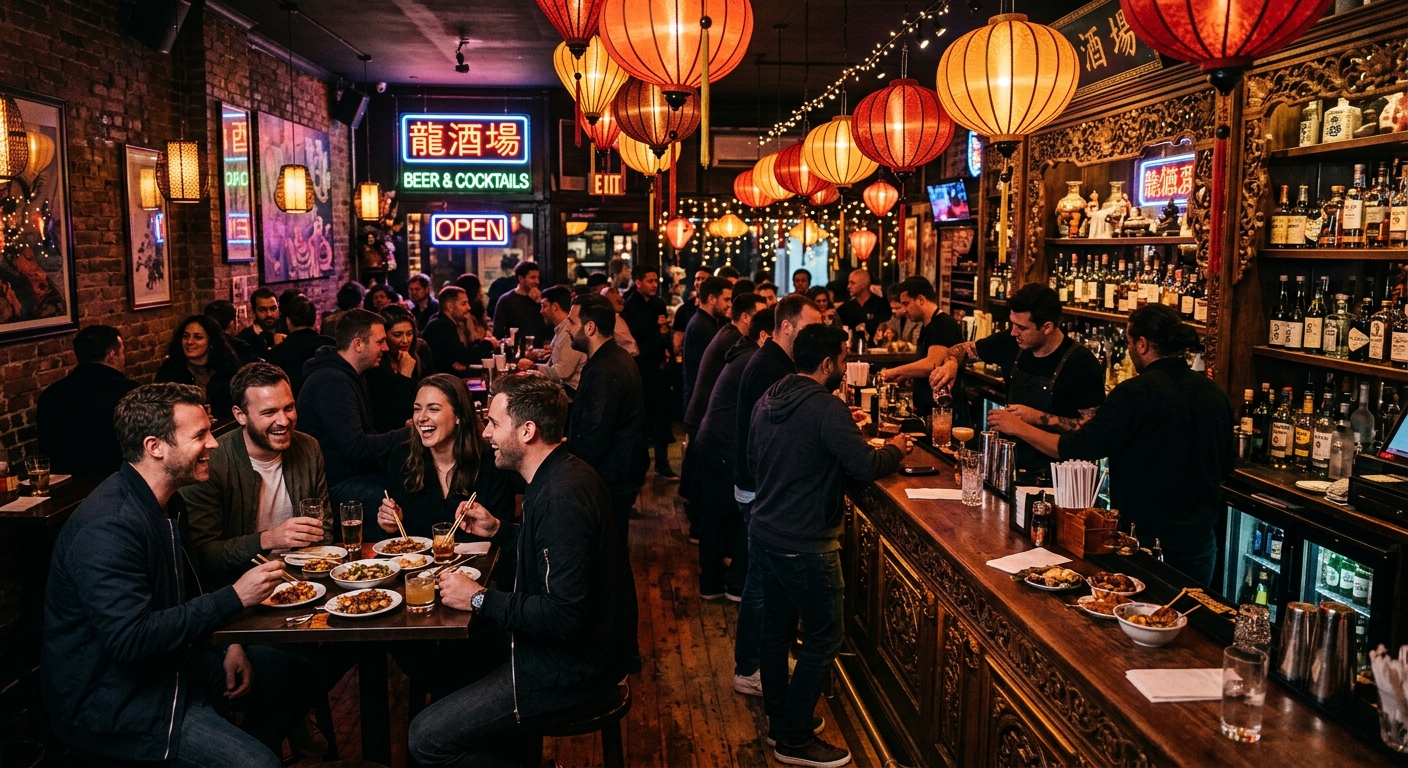
Venues like Lucky Chan in Hebbal are designed to capture the after-office crowd from nearby tech parks.
Yeshwanthpur: From Warehouses to Weekend Plans
The Yeshwanthpur–Tumkur Road belt, historically a wholesale and industrial zone, is undergoing a quiet reinvention. Metro connectivity on the Green Line and new residential towers around the Orion Mall and World Trade Center cluster have primed the area for mixed-use development. The most visible signal of this shift is the expansion of Byg Brewski into Yeshwanthpur. The brand, known for its sprawling, garden-style breweries in Hennur and Sarjapur, targets high-land-availability areas on the outer ring. Its arrival validates Yeshwanthpur as a viable nightlife destination, proving that even transitional industrial belts can support destination-scale venues as manufacturing plots give way to residential and office projects.
South Stories: JP Nagar and the ORR Brewery Trail
The southern arc—anchored by JP Nagar, Bannerghatta Road, and the ORR stretch toward Kanakapura—is building a distinct brewery circuit. This is a more residential, family-tilted scene, with large-format brewpubs offering weekend brunches, live music, and sprawling terraces. Mezera Brewery & Kitchen in JP Nagar is a prominent example, catering to mid-to-upper-income professionals who work in the Bannerghatta tech clusters, BTM, and Electronic City. Other bars and brewpubs along the southern ORR, including those near RMZ Ecoworld in Bellandur and Prestige Tech Park in Marathahalli, reinforce the pattern: nightlife is following the office campuses and residential enclaves, creating hyper-local options for a workforce that no longer needs to commute to the central core for a quality evening out.
The Live-Work-Play Ecosystem Takes Shape
The new openings are not random. They align with a broader urban shift toward self-contained live-work-play ecosystems. Tech parks like Manyata, RMZ Ecoworld, and Prestige Tech Park now function as anchors for surrounding F&B, retail, and entertainment. Breweries are increasingly treated as anchor tenants within these mixed-use developments. BLR Brewing Co.’s outlet at Prestige Tech Park in Marathahalli is designed to serve the campus’s large workforce, turning the after-office drink into a walkable ritual. Similarly, Chin Lung Brewery’s new flagship in Marathahalli is framed as a community and events hub for the ORR tech corridor. When a mall like Phoenix Mall of Asia integrates cinema, shopping, and multiple bar concepts in one campus, it creates a complete weekend ecosystem within a 3-kilometer radius of thousands of homes.
What It Means for Young Professionals
For the city’s young professional class, this decentralization is quietly reshaping daily life. Rental decisions are increasingly influenced by proximity to these new clusters—brokers now pitch apartments as “10 minutes from Phoenix Mall of Asia” or “walking distance to the new brewery.” Weekday socializing becomes hyper-local: a quick team drink at SOCIAL on New BEL Road, or a post-work dim sum session at Lucky Chan in Hebbal, replaces the old ritual of a long drive to Indiranagar. Weekends may still involve crossing the city for a special occasion, but the default question has shifted from “What’s happening in Koramangala?” to “What’s good within 15 minutes of home?” This is a fundamental change in how young Bengalureans allocate their time, money, and commute tolerance.
Neighborhood Identities and Micro-Nightlife Guides
Each emerging cluster is developing a distinct identity. Hebbal and Nagavara feel like a mall-and-tech-park ecosystem, polished and upscale. New BEL Road retains a younger, student-friendly energy with Instagram-ready bars and affordable cocktails. Yeshwanthpur carries a transitional, industrial-chic vibe, marked by the arrival of mega-breweries. JP Nagar and the southern ORR belt are residential and family-oriented, with brunch menus and live acoustic sets. These differences matter for city guide platforms: they create opportunities for micro-nightlife guides tailored to each zone, rather than monolithic “Bengaluru nightlife” coverage. The next evolution could be distinct neighborhood crawls—a Hebbal bar trail, a South Bangalore brewery circuit—each with its own rhythm and audience.
Tensions, Trade-Offs, and the Road Ahead
This shift is not without friction. Long-time residents in areas like JP Nagar and Hebbal may be ambivalent about the transformation from quiet residential neighborhoods to nightlife hubs, raising concerns about parking, noise, and crowding. There are also questions about over-supply: with multiple large-format breweries opening in a short span, footfall sustainability is a real risk, though operators argue that non-overlapping catchments reduce direct competition. Some industry voices still insist that central Bengaluru delivers the highest brand visibility, framing peripheral venues as satellite markets. Yet the scale of investment—1,500-seater breweries, multi-crore fit-outs, and anchor roles in tech parks—suggests that investors see these areas as primary bets, not overflow. As metro lines extend toward Hebbal and along the ORR, the infrastructure will only reinforce the polycentric pattern, making it easier to bar-hop within zones rather than drive into the CBD.
Sources
Bengaluru's Chin Lung Brewery expands with Marathalli outlet
BLR Brewing Co. Opens Fifth Outlet at Prestige Tech Park, Marathahalli
Blr Brewing Co. Launches India's Largest Brewpub in Bengaluru
Restaurant India News: Mount Everest Breweries launches STOK beer in Bengaluru
New bars in Bangalore that promise the most 'buzzed up' nights out
Red Rhino launches commercial brewery to accelerate market expansion
India's largest microbrewery Byg Brewski to set up in Pub city of Bengaluru
Bengaluru’s Craft Beer Scene Expands with ICB-Indian Craft Brewery Launch