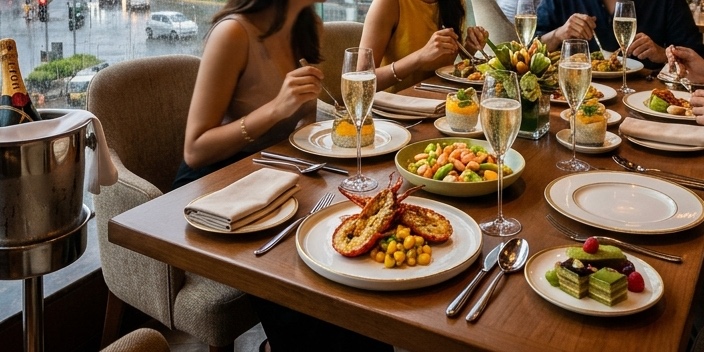
From Scheme 54 to Kanadiya Road: How Peripheral Neighbourhoods Are Quietly Reshaping Indore’s Café Culture
Explore how new 2026 cafe openings in Kanadiya Road, Usha Nagar, LIG, and Bicholi Bypass are shifting Indore's food culture beyond Scheme 54 and Vijay Nagar.


An Evening at the New Edge of Indore
The sun sets over the Bicholi Bypass, and the poolside at Palmira begins to shimmer under strings of warm bistro lights. A few kilometres away, on a rooftop in LIG’s RSS Nagar, families settle into wicker chairs at BUNGLOW NO.6, the aroma of vegetarian sizzlers drifting through the air. Neither scene is unfolding in the familiar culinary corridors of Scheme 54 or Vijay Nagar. Instead, these moments are taking place in what were once considered purely residential or transit-heavy peripheries. In 2026, Indore’s food geography is undergoing a quiet but decisive shift, moving from a monocentric model of dining to a distributed network of neighbourhood micro-hubs. The grand openings of branded outlets like Utsah’s fifth branch on Kanadiya Road and TINKU’S in Usha Nagar are not random experiments; they are markers of a structural change in how the city eats out.
The Old Guard: Saturation in Scheme 54 and Vijay Nagar
For over a decade, Vijay Nagar and Scheme 54 have been the undisputed anchors of Indore’s café and casual dining culture. These high-density commercial pockets offered visibility, footfall, and a critical mass of competing brands that turned evenings into a bustling social ritual. However, this concentration has brought familiar urban pressures: spiralling commercial rents, severe parking congestion, and a saturation of concepts that makes it difficult for new entrants to stand out. The very success of these hubs has created a centrifugal force, pushing operators to look for breathing room and untapped catchment areas. The result is a natural spillover into the residential belts that have quietly grown in population and infrastructure, waiting for their moment on the culinary map.
Kanadiya Road: The Rise of a New Café Strip
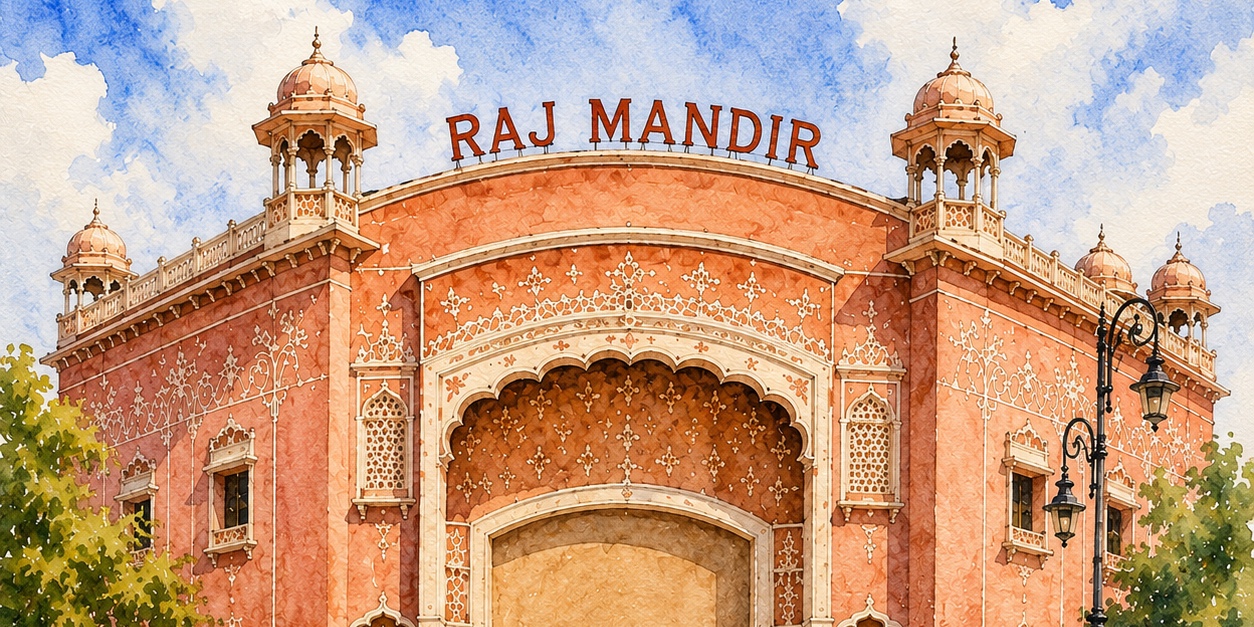
Kanadiya Road is emerging as a prime example of this gravitational pull. The corridor, anchored by large-format retail like D-Mart, has long had a smattering of small cafes and fast-food joints, but it lacked a high-identity brand pull. That changed with the announcement of Utsah Restaurant & Cafe’s fifth outlet, positioned directly in front of D-Mart in Gokul Nagar. The grand opening, scheduled for 12 June 2026, signals a significant vote of confidence in the area's demand potential. Utsah’s decision to place a multi-branch chain here, rather than a standalone experiment, transforms the strip from a purely residential thoroughfare into a legitimate dining destination. The existing presence of venues like Emojis Cafe on Kanadiya Main Road had already validated the local appetite; Utsah’s arrival crystallises the trend, leveraging anchor retail footfall to establish a new normal for the neighbourhood.
Usha Nagar: TINKU’S and the Neighbourhood Network Strategy
A similar pattern is unfolding in Usha Nagar, where TINKU’S opened its doors on 30 April 2026 at Usha Nagar Extension, in front of Ranjeet Hanuman Mandir. This is not a lone outlet but a link in a deliberate multi-locality expansion chain. The brand’s social media presence tags its other city locations, framing Usha Nagar as an integral part of a distributed network rather than an isolated satellite. The area already possessed a modest cluster of casual eateries, with listings showing spots like The Smily Cafe operating nearby. TINKU’S entry represents a strategic upgrade: a recognised brand moving into a pocket where small independents have already proven the existence of a captive, local audience. It is a 'follow the neighbourhood' model, placing established concepts directly into the daily lives of residents who previously had to commute for a similar experience.
LIG and RSS Nagar: BUNGLOW NO.6 as a Destination Anchor
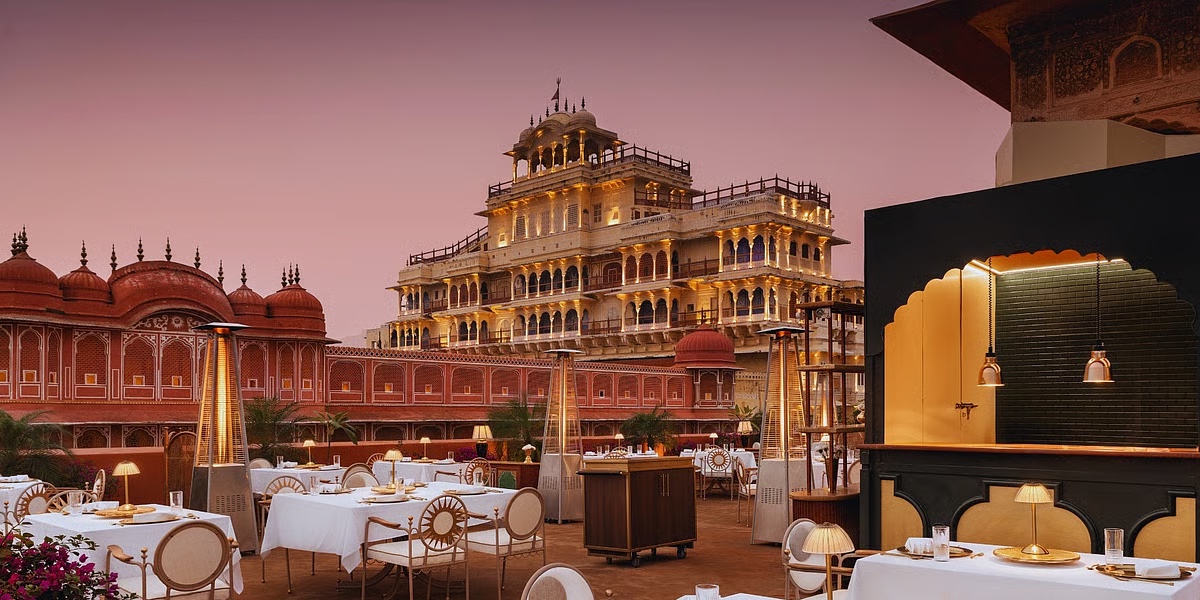
Perhaps the most striking example of a peripheral destination is BUNGLOW NO.6, situated on MIG Main Road near LIG Square in RSS Nagar. Highlighted by local food curator Indorizayka as a 'NEW PLACE IN INDORE,' this venue is a high-concept, vegetarian-only rooftop café. With a typical price point of around ₹1800 for two and operating hours stretching from 11:00 to 23:30, it is designed as a full-day destination. Its location just off AB Road, yet firmly anchored in the LIG residential belt, pulls a new pin onto the mental map of Indore’s food lovers. BUNGLOW NO.6 proves that a destination café does not need to be in a traditional 'hangout neighbourhood'; it can create its own gravity, serving both local residents on a whim and drawing drive-in visitors from across the city seeking a specific ambiance.
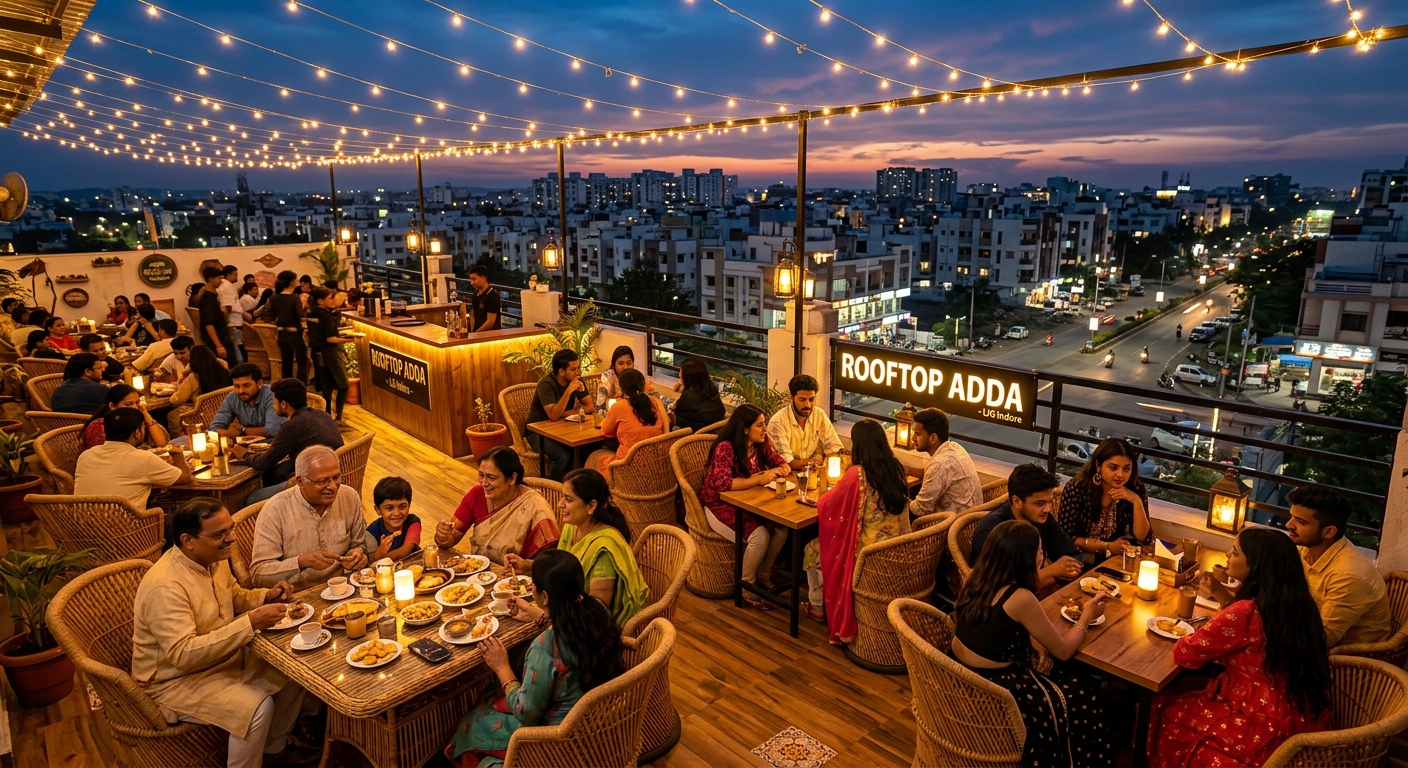
BUNGLOW NO.6 and similar venues are turning residential LIG into a standalone dining destination, reducing the need to travel to Vijay Nagar.
Bicholi Bypass: Palmira and the Highway-Side Escape
On the city’s western edge, Palmira at the Blue Leaf Hotel on Bicholi Bypass Square redefines a transit corridor as a leisure destination. Opening on 1 May 2026, Palmira is marketed as a 'pure veg escape' that fuses poolside luxury with boho café aesthetics. Located on the Mumbai-Agra National Highway near Sahara City, it leverages resort-style features to attract a dual audience: nearby residents in expanding housing colonies and city-wide visitors seeking a weekend retreat without leaving the urban agglomeration. By positioning itself beside Kalyan Sampat Gardens, Palmira taps into existing leisure traffic while adding a sophisticated dining layer to a road previously known mostly for passing vehicles. It turns the bypass into a place to stop and stay, rather than just drive through.
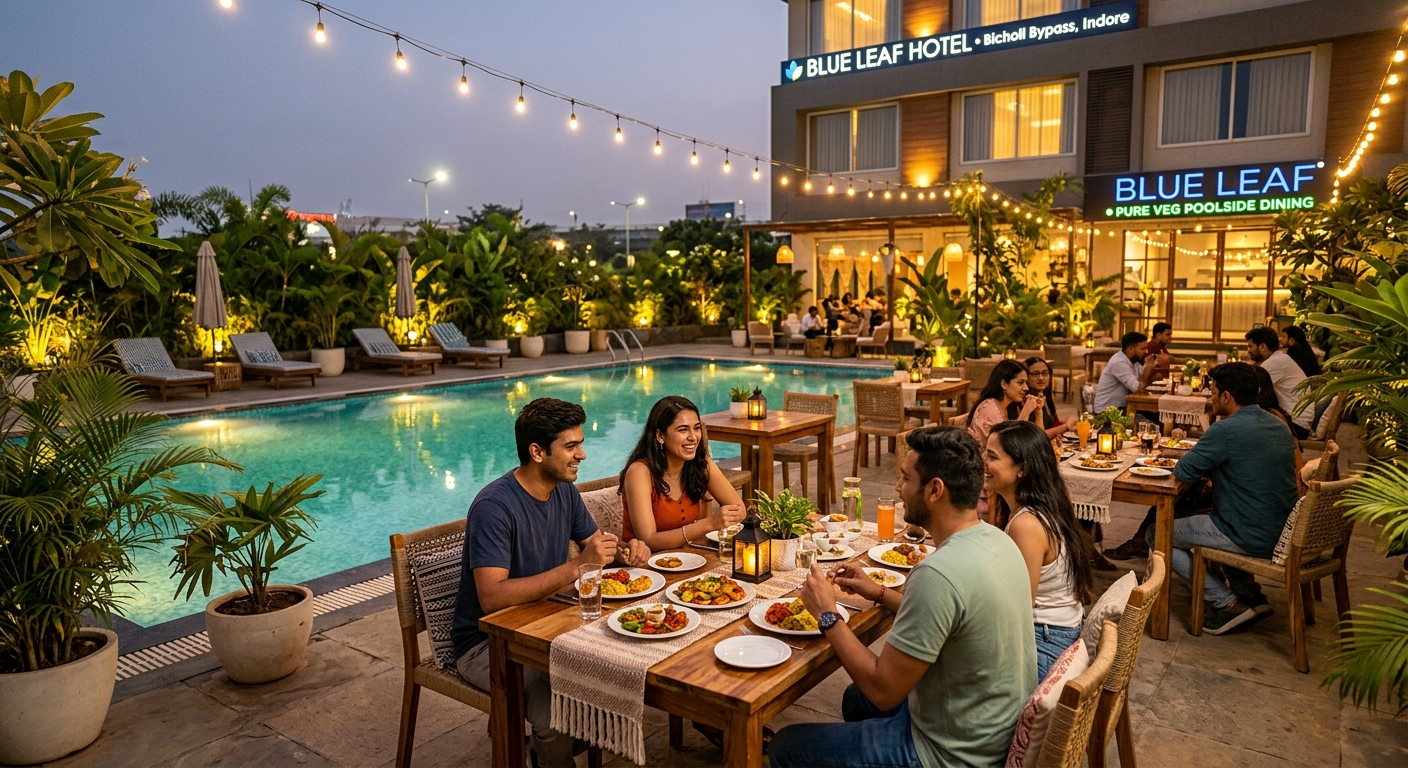
Palmira's opening on Bicholi Bypass redefines the area from a highway pass-through into a leisure escape for the city's western residents.
Indorizayka: The Informal Cartographer of a Shifting Scene
Tracking this decentralisation is a community-driven effort, and no entity captures it better than Indorizayka. Functioning as an informal curator, the platform’s posts—tagged with #NewPlaceInIndore and #NewInIndore—have become a real-time map of the city’s expanding gastronomic borders. From the early February 2026 spotlight on BUNGLOW NO.6 to the video announcement of Palmira’s poolside opening, Indorizayka tells residents where the new energy is flowing. Crucially, the platform goes beyond promotion; its website feature '8 Insights on Food Business in Indore' analyses outlet churn, closures, and consumer behaviour, providing a grounded, data-aware context to the hype. For a resident scrolling through their feed, these posts redraw the mental map of 'going out,' replacing a singular focus on Vijay Nagar with a constellation of accessible neighbourhood options.
Why Decentralisation Matters for Residents and the City
The immediate benefit for residents is a dramatic reduction in the friction of daily leisure. A family in Kanadiya Road no longer needs to brave crosstown traffic for a branded café experience; a group of friends in Usha Nagar can walk to a familiar multi-location eatery. These venues anchor local social life, creating micro-destinations that strengthen neighbourhood identity. For the broader city, this represents a maturation of urban living. The narrative shifts from 'a few famous areas' to a city of many parallel hubs, each with its own character. This pattern mirrors wider retail trends, where housing growth and improved road infrastructure invite branded outlets to follow the rooftops. However, as Indorizayka’s insights on business churn remind us, an opening does not guarantee longevity. The sustainability of these new hubs will depend on how well they differentiate themselves, manage pricing, and integrate into the daily fabric of their specific catchments rather than just replicating a generic formula.
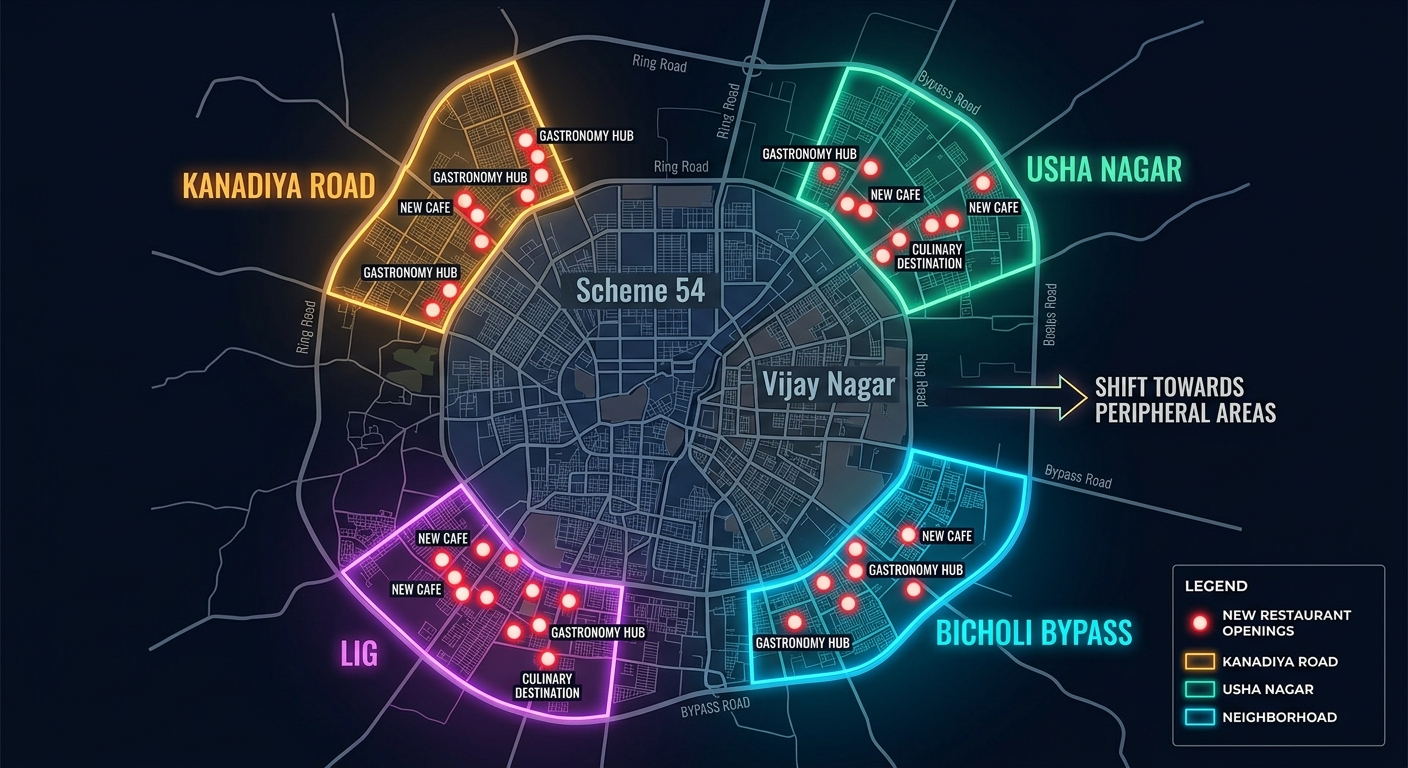
The 2026 wave of openings is redrawing Indore's food geography, creating multiple parallel hubs beyond the traditional central clusters.
A City of Many Food Neighbourhoods
The concentrated wave of openings between February and June 2026—from BUNGLOW NO.6 to Utsah’s Kanadiya Road launch—is not a story of the old city centre declining. Vijay Nagar and Scheme 54 remain dense, vibrant anchors. What is changing is the rise of multiple parallel hubs that offer comparable lifestyle amenities closer to home. For residents, tracking where the next outlet opens in a peripheral neighbourhood is no longer just a curiosity; it is a practical lens for understanding how their city is evolving and a guide to the new rhythms of everyday life. Indore’s café culture is no longer a single, crowded room; it is a house with many doors, opening onto Kanadiya Road, Usha Nagar, LIG, and Bicholi Bypass.
Sources
Frequently Asked Questions
Why are new cafes opening in Indore’s peripheral areas like Kanadiya Road instead of Vijay Nagar?
New cafes are moving to Kanadiya Road, Usha Nagar, LIG, and Bicholi Bypass due to high rents and saturation in central hubs like Vijay Nagar and Scheme 54. These peripheral areas have growing residential populations and anchor retail spaces like D-Mart, offering a captive local audience and room for high-concept venues to become neighbourhood destinations.
What are the major new restaurant openings in Indore’s peripheral neighbourhoods in 2026?
Key 2026 openings include Utsah Restaurant & Cafe’s fifth outlet on Kanadiya Road (opening 12 June), TINKU’S in Usha Nagar Extension (opened 30 April), BUNGLOW NO.6 in LIG/RSS Nagar, and Palmira, a pure-veg poolside restaurant at Blue Leaf Hotel on Bicholi Bypass (opened 1 May).
How does Indorizayka help track new food outlets in Indore?
Indorizayka acts as an informal curator of Indore’s food scene, using social media posts tagged with #NewPlaceInIndore to announce openings like BUNGLOW NO.6 and Palmira. The platform also publishes analytical insights on food business trends and outlet closures, helping residents discover new spots and understand the evolving local market.
Is the food scene in Vijay Nagar and Scheme 54 declining because of these new openings?
No, the rise of outlets in peripheral areas does not signify a decline in Vijay Nagar or Scheme 54. It reflects a decentralisation trend where multiple parallel hubs are emerging to serve different residential catchments. The old centres remain dense and vibrant, while new neighbourhoods gain comparable lifestyle amenities closer to home.
What risks do new cafes face when opening outside Indore's traditional food hubs?
While decentralisation improves local access, sustainability is not guaranteed. Outlet churn is a documented reality in Indore's food business, and success in peripheral areas depends on sustained local patronage, competitive pricing, and differentiation. Simply opening in a new locality does not ensure viability without a strong concept and community integration.