
12 Nov|6m read|Updated 23 May
Jaipur's Biggest Artificial Lake Facing Environmental Crisis
Discover the alarming decline of Jaipur's largest lake, exploring the environmental challenges, causes, and potential solutions to save this vital water resource.
CommunityCommunity
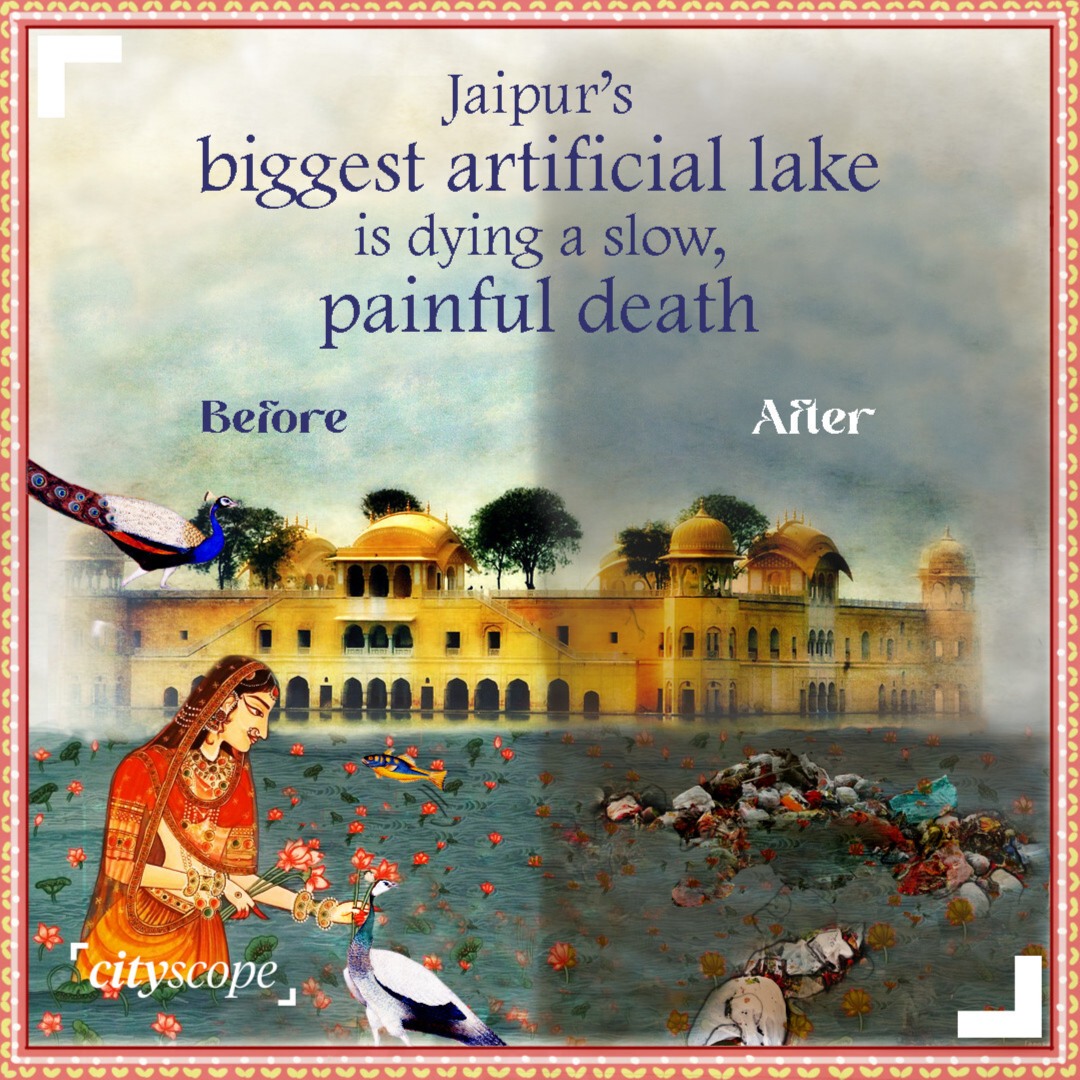

(Image credits: corecommunique.com)
A 17th-century artificial lake in Jaipur has gone from being an abode for exotic flora and fauna to a garbage-infested spot sporting plastic bags and sewage. Constructed during the reign of Mirza Raja Man Singh, the 29th Kachwaha Rajpur Raja of Ajmer—one of Mughal emperor Akbar’s most trusted and loyal generals—the Man Sagar lake used to be the primary source of drinking water for the people of Jaipur. Embodying Jal Mahal in all its beauty, the lake is not only a picturesque sunrise spot serving up a serene view but also a water body that hosts a variety of marine life. The fauna around it increases tenfold when different endangered bird species fly over its waters during the migrating season, making it a bird watcher’s delight. In fact, it (the lake) used to be a popular hunting spot for the Rajput kings of Jaipur. Now, dead fish are found floating on the surface of the lake; garbage is lodged on the banks, and sewage flows in continuously. The lake now struggles to sustain any life possible.
Ecological Disturbance in the Lake
The marine ecosystem of the vicinity has been severely affected over the past two decades—a direct byproduct of the ever-evolving landscape. Jaipur’s sewage, along with the occasional rainwater, mixes into the lake to form a stench that pushes locals and tourists away from it. To make matters worse, huge piles of garbage disposed of in the lake usually wind up on the banks.
Despite being placed under the Rajasthan Lake Development Authority (RLDA), conservation efforts have failed in making any difference. Sewage, fertilizers, pesticides, human feces, and even illegal encroachments, continue to contaminate this ancient lake.
A study conducted by the Rajasthan Pollution Control Board (RPCB) found that the water in Man Sagar lake has turned toxic. The study also revealed that the dissolved oxygen rate in the lake is below the required level to sustain any aquatic life. The oxygen rate in the lake stands at 2.33mg per liter as compared to the required minimum of 3mg per liter—which explains the hordes of dead fish found floating on the water's surface.
Why should we care?
Water reservoirs and lake bodies are of immense importance, especially in arid regions such as Rajasthan. Jaipur has already lost 60 out of 518 rivulets; more than 1000 wells/tube wells have stopped recharging due to an unprecedented increase in the total paved area. Encroachments on natural drains have also made Jaipur prone to flooding. In such cases, lake bodies such as the Man Sagar Lake act as a buffer and absorb the excess rainfall water, preventing flood-like situations. This proves that the lake may be more crucial for the city of Jaipur than any of us had anticipated.
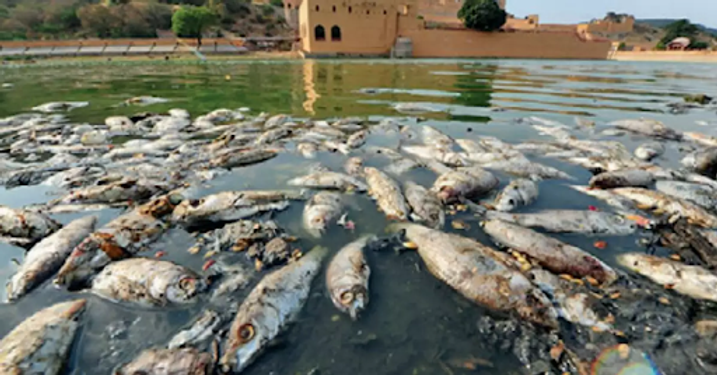
Image credits: TOI
The Problem
To blame tourists and locals for disposing of their garbage in Man Sagar lake would be easy. But if we take a closer look at things, we can see that the sanctity of Man Sagar lake was preserved until the walled city of Jaipur was ruled by the Maharajas. It was only in the year 1962—when the Jaipur administration decided to divert sewage from the walled city to the lake using the channels of Brahmpuri nallah and Nagtalai nallah—that it led to a growth in aquatic weeds like water hyacinth, which in turn suppressed the algal growth and added dead organic pollution load, ultimately leading to a fall in the fish count of the water body. As a result, an unbearable stench emerged from the lake, whose bed was now filled with sewage-soaked silt.
Revival Of The Marine Ecosystem
Several attempts have been made over the years to revive the marine ecosystem, but the lake continues to struggle, and the aquatic life continues to gasp in the polluted lake water. The first considerable effort was made in 1999, when the government, in an attempt to revive the ecosystem of the lake, decided to partner with a private enterprise for a complete makeover of the lake. Several Sewage Treatment Plants (STPs) were installed to treat the sewage before releasing it into the lake. The lake bed was dredged to increase its depth from 1.5 meters to 3 meters to ensure that it (the lake) doesn’t run dry in the summers. Artificial islands were constructed to attract migratory birds and giant bubblers were also installed for aeration of the lake. As a result of these efforts, marine life thrived once again in and around the lake, with glimpses of migratory birds flying over it once again. However, all of this was short-lived.
The Brahmpuri Sewage Treatment Plant (BSTP) went defunct after some years and continues to be dysfunctional. The JMC (Jaipur Municipal Corporation), which was initially given the responsibility to ensure sewage is treated before it is released into the lake, has not stepped up to its role. Despite the state government listing Jal Mahal as a protected site, sewage water still continues to be released into the lake. Even after several warnings issued by the district collector, the JMC has failed to restart the defunct STP, thereby undoing years of efforts to revive the lake’s ecosystem.
A Silver Lining
The despondent state of Man Sagar Lake has encouraged the people of Jaipur to come forward and work for a change that they wish to see. Several NGOs and civic societies have organized cleanup drives in the vicinity of the lake, as well as spread awareness and a strong social message to the authorities. In June 2019, over 150 volunteers invited by the Green Dream Foundation organized a lake cleanup drive and collected garbage weighing over 1.5 tonnes. Although the NGOs are doing a commendable job in their attempts at preserving the lake, their efforts might go in vain if the state doesn’t step in. To make sure that the preservation efforts made during 1999-2004 are not misspent, the administration needs to step up to preserve this antique lake.
Resources:
Polluted Mansagar lake now becomes nightmare for locals: Times of India
Mansagar's fate hangs in balance: Down to Earth
A step towards Mann Sagar Lake clean up in Jaipur: Core Sector Communique
Government declares Jal Mahal, Man Sagar lake protected: Times of India
Clean lake drive yields 1.5-tonne trash: Times of India Twitter