


Mumbai Faces Surge in Heatstroke Cases Amid Rising Temperatures
Mumbai is witnessing a rise in heatstroke cases due to soaring temperatures, with health experts urging caution as the heatwave continues.
Amit Shah, the union home minister, presented social worker Appasaheb Dharmadhikari with the Maharashtra Bhushan award during a government event that an estimated 2 million people attended.
This event was held in the summer afternoons when temperatures often exceed 35 degrees Celsius.
What is a heat stroke and how it happens?
The overheating of the body due to exposure to high temperatures and humidity, or sustained physical exertion at high temperatures, causes a heat stroke or sunstroke. A heat stroke is regarded as a medical emergency that needs to be treated right away.
The body's core temperature rises when the body is unable to sweat and, as a result, cannot expel heat through evaporation. The body's core temperature can rise to 106 degrees Fahrenheit in a matter of minutes if it is unable to cool down. Dr. Akshay Yadav warned that this could have fatal health effects.
Fatigue, headaches, nausea, vomiting, hypotension (low blood pressure), and tachycardia (increased heart rate) are all symptoms of heat exhaustion.
Rising cases of heat strokes in Maharashtra
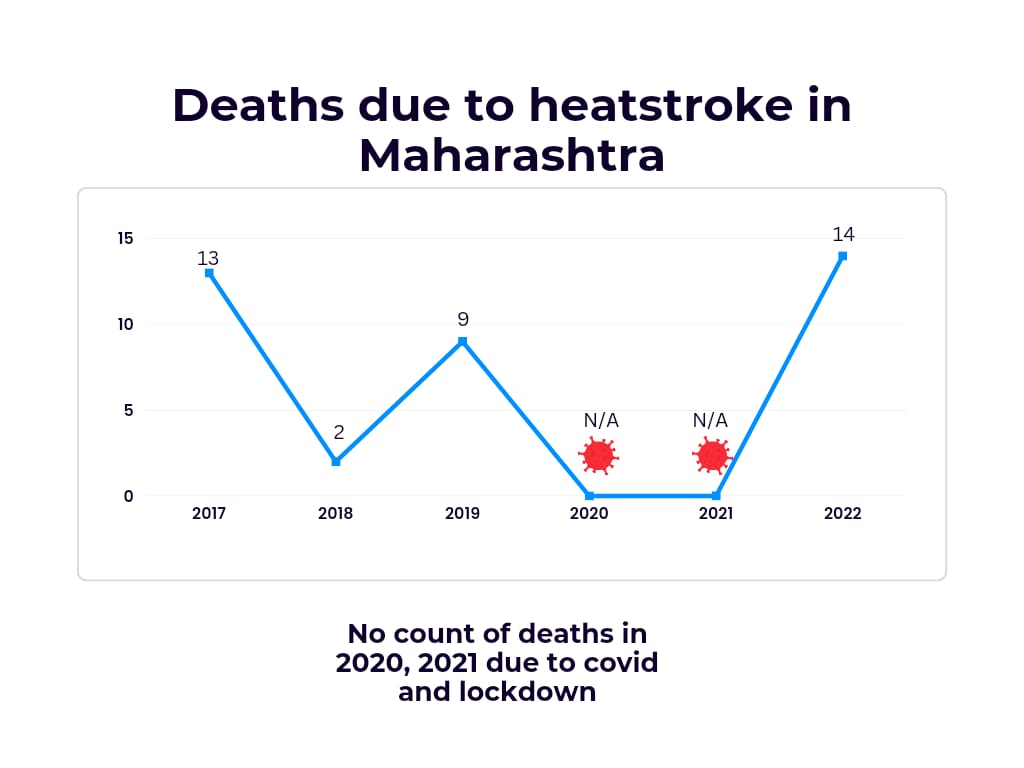
In 2022, Maharashtra experienced the greatest death toll from heat stroke at 25. The health department's data indicated that over 374 cases of heat stroke were registered in March and April clocking in a five-year high, while experts believe the actual number may be significantly higher.
According to data published by state health departments, Maharashtra has seen a steady rise in heatstroke cases in 2023. Between March 1 and April 17, the state reported 475 suspected cases, which is a hundred more cases than the previous year. It's important to note that this figure does not include individuals who were affected by the heat during the Maharashtra Bhushan award ceremony in Kharghar, Mumbai.
The state government also instructed the health apparatus to report heat stroke deaths, which typically go unreported and are recorded under other headings (causes) of death. The administration is currently drafting a comprehensive manual outlining the precautions and actions that must be followed by various departments at the district level.
Furthermore, a report by the Business Standard last year which stated-In spite of the fact that data for the previous two years are not yet available by country, data from the Ministry of Statistics and programme implementation's annual Envistats release reveals that from 2016 to 2020, heatstroke accounted for 13.6% of all fatalities brought on by natural disasters. Heatstroke was the cause of 5,159 of the 38,070 deaths brought on by natural disasters in the country.
No data on deaths in 2020-21
Our research found that deaths caused by heat stroke went unnoticed in the years 2020 and 2021, thus Maharashtra Government not having data on the same.
A resident doctor from Lokmanya Tilak Hospital in Sion, Mumbai revealed that the treatment was prioritised to the covid patients and the municipal body along with the state had allocated resources and time for battling the growing infections, thus having no record on the same.
“Most of our hospitals were overburdened with new cases on a daily basis, even other diseases were left unrecorded to a great extent,” he added.
“Moreover, our teams have not treated many heat stroke patients as most people remained indoors and temperatures were quite forgiving those years,” he continued.
Climatic conditions causing heatstroke, the wet bulb effect
The maximum and minimum temperatures provided in weather bulletins do not provide the full picture. Their findings are based on readings from ordinary dry bulb thermometers, however, to provide accurate readings of the temperature and its effect on the human body, a tool named wet bulb is used.
The wet-bulb temperature is the temperature read by a thermometer covered in water-soaked cloth over which air is passed. At 100% relative humidity, the wet-bulb temperature equals the air temperature; at lower humidity, the wet-bulb temperature is lower than the dry-bulb temperature because of evaporative cooling.
Wet bulb temperature readings are more accurate during climate change and global warming. It assesses a location's suitability for human habitation and takes heat and humidity into account. It explains the effects of heat and humidity on the body's capacity to regulate its internal temperature.
What can be expected this summer?
The end of the La Nina phase in the equatorial Pacific Ocean, which generally cools the Earth's atmosphere, is expected to cause the summer of this year to be extremely hot. According to updated predictions, El Nino, which has the opposite effect of La Nina, is predicted to start acting as early as the May to July timeframe.
The extraordinarily high temperatures were dubbed the "worst April heatwave in Asian history" by scientist and weather historian Maximiliano Herrera.
This is likely to make the summer extremely hot, but it may also this likely to make the summer extremely hot, but it also may reduce India's monsoon season's rainfall.
Like this article? Share it with your friends


