
2 Apr|6m read|Updated 9 Jan
India's Dwindling Legacy with Press Freedom: A Growing Concern
Delve into the challenges facing press freedom in India, examining the impact on democracy, public discourse, and the future of journalism in the country.
CommunityEntertainment
India has been ranked 150 out of 180 countries in the latest edition of the Press Freedom Index released by global media watchdog Reporters Without Borders (RSF)—thereby falling eight places since 2021 when the country was ranked 142.
Our country’s ranking in the PFI has been on a constant decline since 2016, with RSF holding the Modi-led BJP government responsible for the dismal state of Indian media.
“The violence against journalists, the politically partisan media and the concentration of media ownership” are some of the reasons highlighted by the RSF for India’s poor ranking on the Press Freedom Index.
While India ranks 150, Russia ranks 155, Pakistan 157, China 175, and North Korea 180.
Understanding PFI: How is it calculated?
The Press Freedom Index is an annual report published by the RSF, aimed at evaluating the level of freedom enjoyed by the media in 180 countries.
The ranking is based on a scale of 0 to 100; each country’s score is evaluated using five contextual indicators that highlight the press freedom situation in their respective country. These are: 1) Political context 2) Legal framework 3) Economic context 4) Sociocultural context and 5) Safety.
A questionnaire is then drafted keeping in mind the key indicators, which are then answered by a network of freedom of expression NGOs, correspondents, jurists, and human right activists from around the world.
RSF is a non-profit, non-governmental, global media watchdog that monitors the freedom available to the Press in different countries throughout the year.
The organization also has a real-time indicator of journalists arrested or killed in a particular region/country, as well as a database of articles related to incidents of curtailment of press freedom in nearly all 180 countries.
Why does India rank low on the index?
According to the RSF: “The violence against journalists, the politically partisan media, and the concentration of media ownership all demonstrate that press freedom is in crisis in the world’s largest democracy, governed since 2014 by Prime Minister Narendra Modi, the leader of the Bharatiya Janata Party (BJP) and the embodiment of the Hindu nationalist right.”
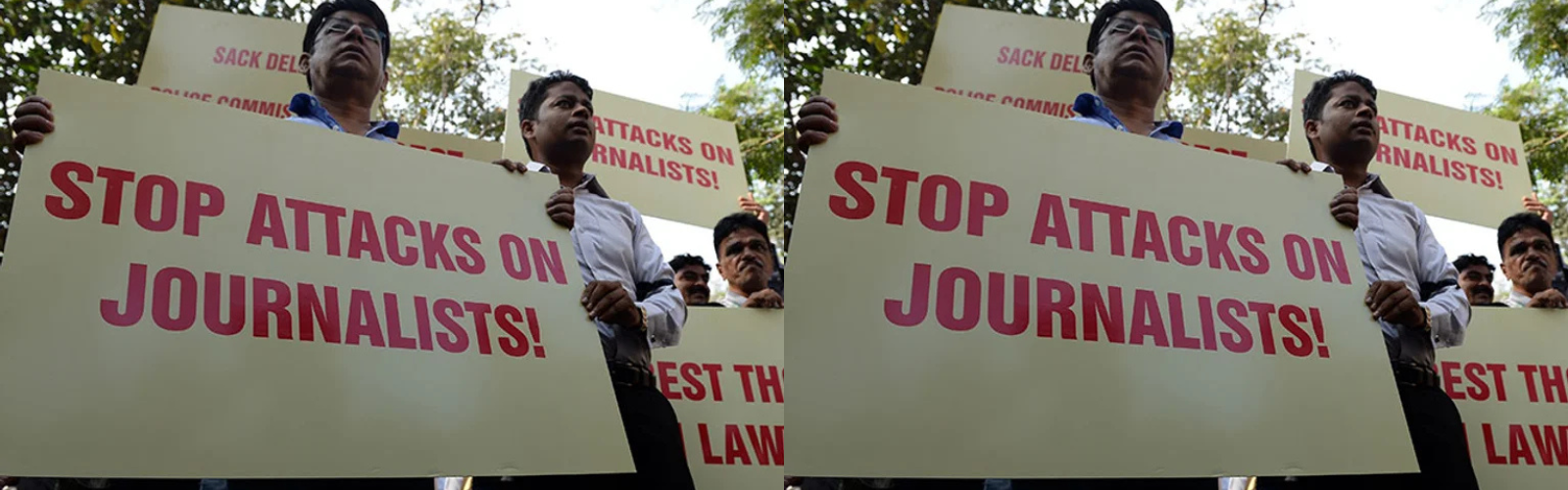 Media person protesting against Attacks on Journalists (Image credits: Asia Society)
Media Ownership
The report justifies the ranking given to India by providing a multifold of reasons. It claims that the Indian media scenario changed drastically post the 2010s, specifically since “Narendra Modi became prime minister and engineered a spectacular rapprochement between his party, the BJP, and the big families dominating the media.”
The report says that businessmen and Modi's close aide Mukesh Ambani-owned Reliance group have acquired over 700 media companies in India, followed by over 800 million viewers, thereby directly influencing the news.
It (the report) also states that Modi’s followers have taken it upon themselves to harass and attack the journalists who are critical of the government.
Legal Battles
Although India has scored fairly well under the legal framework indicator, there are still several cases where reporters, journalists, and media persons are subjected to harsh sedition laws, even terrorist laws in some cases. The report goes on to accuse the Indian government of detaining several media persons covering protests or demonstrations against the government.
Notably, Mandeep Punia, a freelance journalist who writes for The Caravan was arrested at the protest site during the year-long farmer’s protest; he was released after a brief period of time.
According to the report, several journalists were also detained for writing against the government’s handling of the COVID-19 pandemic.
“These repeated violations undermine media’s self-regulatory bodies, such as the Press Council of India (PCI) and the Electronic Media Monitoring Centre (EMMC),” says the report.
Sociocultural disparity and Violence against Journalists
The report further sheds light on the socio-cultural disparity in the Indian media—where only upper caste Hindu men are found holding senior positions in the media. Less than 15% of female journalists are found hosting evening TV news shows.
During the COVID-19 lockdown, some TV channels went on to blame a particular religious community for the spread of the virus, states the report.
RSF’s report labeled India as one of the world’s most dangerous countries for journalists, singling out the situation in Kashmir and the treatment the Press gets in this particular region.
How reliable is PFI?
Several governments and institutions—including that of India—have raised questions and doubts about the authenticity of this report.
An article published by The Niti Aayog in 2020 questions the reliability of the report and raises questions about the opaqueness of the survey.
“Question-wise or category-wise scores used in computing scoresfor the six parameters are not made public, nor is the list of respondents provided,” states the article. “Similarly, clearly defined, credible sources are not available for quantitative data on abuse and violence against journalists, nor is any attempt made to clarify such data with Government or country-wise sources in any of the countries being ranked.”
The Indian government also says that the report has consistently ranked the developing countries of South Asia much lower than the developed European ones—further pointing out how the board of directors at RSF is devoid of a representative from Asia.
The Niti Aayog article further goes on to argue that RSF provides no information about its funding; it (the article) points to certain speculations that the RSF is funded by the governments of particular countries and multilateral agencies such as the Soros Foundation, which in turn raises questions about the organization’s independence, motivation, and ideology.
Niti Aayog further says that after RSF’s 2018 ranking, the Press Counicl of India (PCI) had written to the organization several times in order to understand how the rankings are allotted and how the index was prepared but had not heard back from them.
After the 2022 PFI report was released, which ranked India at a dismal 150, the government rejected PFI’s claims stating that the findings of the PFI were inaccurate and illegitimate because of a “very low sample size, little or no weightage to fundamentals of democracy, adoption of a methodology which is questionable and non-transparent”.
While the RSF’s ideology and methodology may arguably have certain flaws, it cannot be said that their reservation about the curtailment of freedom in Indian media is entirely misplaced. The amount of pushback—and even hate—received by journalists such as Rana Ayyub, Ravish Kumar, and Karan Thapar are a testament to the fact that journalists in India are not exactly “safe”. In light of cases such as the Bulli Bai app and Bhima Koregaon, the Indian government cannot explicitly reject the claims of the Press Freedom Index, but instead, should investigate and act upon the shortcomings of the system in order to make the Indian media bias-free and safe.
Resources: