
How to Balance Perfectionism and Protect Your Mental Health
Explore spiritual leader Sri Sri Ravi Shankar's (Gurudev) profound framework on overcoming toxic perfectionism and practicing radical self-acceptance.
In an era dominated by hustle culture, hyper-productivity, and the curated perfection of social media, millions of people are silently moving toward a state of chronic exhaustion. The relentless pursuit of flawless execution whether in our careers, relationships, or personal lives has triggered a global mental health crisis.
When the gap between our expectations and reality widens, emotional distress follows.
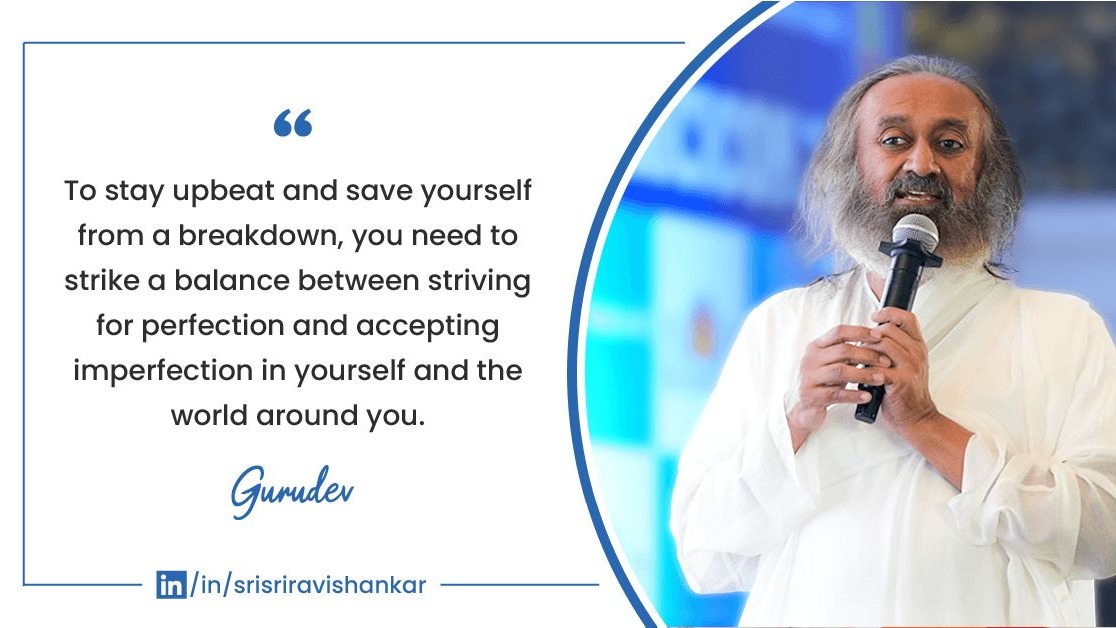
A profound blueprint for surviving this modern trap is perfectly captured in an insight shared by global humanitarian and spiritual leader, Sri Sri Ravi Shankar (affectionately known as Gurudev).
"To stay upbeat and save yourself from a breakdown, you need to strike a balance between striving for perfection and accepting imperfection in yourself and the world around you." — Gurudev
How do we implement this balance in a world that demands flawless results? This comprehensive guide breaks down the psychology of toxic perfectionism, analyzes Gurudev’s philosophical framework, and offers actionable strategies to stay mentally resilient.
The Core Problem: Why the Pursuit of Perfection Leads to a Mental Breakdown
Perfectionism is frequently disguised as a positive trait, a badge of honor worn by high achievers. However, cognitive behavioral psychologists distinguish between adaptive perfectionism (striving for realistic excellence) and maladaptive perfectionism (setting unattainable standards paired with harsh self-criticism).
When you cross into maladaptive perfectionism, you invite serious psychological risks:
The All-or-Nothing Mindset: Viewing anything short of 100% success as an absolute failure, which fuels chronic anxiety.
Analysis Paralysis: The fear of making a mistake becomes so debilitating that it leads to severe procrastination and missed opportunities.
Chronic Cortisol Overload: Constantly stressing over minor details keeps your body's fight-or-flight response activated, eventually resulting in a clinical emotional breakdown or physical exhaustion.
To protect your peace of mind, you must shift your perspective from an obsession with flawless outcomes to an appreciation for sustainable progress.
Deconstructing Gurudev’s Wisdom: The Paradox of Striving vs. Accepting
Peace does not come from abandoning your goals, but from changing how you relate to outcomes.
True emotional resilience requires managing a delicate internal paradox:
Striving for Perfection (The Intent): This is your evolutionary drive to improve, create, innovate, and give your absolute best to your work and community. Without it, life stagnates.
Accepting Imperfection (The Cushion): This is the psychological safety net. It acknowledges that human beings are fundamentally flawed, systems break, and external circumstances are frequently beyond our control.
If you only strive without accepting, you break down under pressure. If you only accept without striving, you fall into complacency. Mental wellness lives precisely in the equilibrium between the two.
Perfectionism vs. Excellence: A Mental Health Breakdown
To help you identify where you stand, let’s look at how the drive for perfection contrasts with the pursuit of excellence across key emotional dimensions:
Primary Motivation
Toxic Perfectionism (Breakdown Zone): Driven by the intense fear of failure and judgment by others.
Healthy Excellence (Upbeat Zone): Motivated by a genuine desire for growth, continuous learning, and self-actualization.
Focus Area
Toxic Perfectionism (Breakdown Zone): Obsessing strictly and anxiously over the final outcome.
Healthy Excellence (Upbeat Zone): Finding genuine value, engagement, and joy throughout the entire process.
Reaction to Mistakes
Toxic Perfectionism (Breakdown Zone): Falling into self-loathing, deep shame, and defensive behaviors.
Healthy Excellence (Upbeat Zone): Approaching errors with curiosity, swift course correction, and emotional resilience.
View of the World
Toxic Perfectionism (Breakdown Zone): Holding rigid, unyielding expectations of how things "should" always be.
Healthy Excellence (Upbeat Zone): Maintaining a realistic, peaceful acceptance of life's inherently unpredictable nature.
Standard of Success
Toxic Perfectionism (Breakdown Zone): Demanding absolute, flawless execution—anything less is viewed as total failure.
Healthy Excellence (Upbeat Zone): Focusing on doing one's absolute best with the tools and resources available at the time.
Actionable Strategies to Balance Ambition and Mental Peace
1. Shift Your Metric from "Flawless" to "Iterative"
Adopt the framework used by top tech innovators: the Minimum Viable Product (MVP) mindset. Deliver your work, project, or creative endeavor when it is highly functional, rather than waiting for an imaginary state of flawlessness. Give yourself permission to edit, improve, and evolve over time.
2. Practice Radical Self-Acceptance
When things go wrong, monitor your internal dialogue. Are you speaking to yourself like a harsh critic or a supportive mentor? Remind yourself that a mistake is data, not an indictment of your identity.
3. Establish Clear Boundaries Around Your Energy
Protect yourself from over-allocation. Recognize the point of diminishing returns, where spending three extra hours tweaking a minor detail provides no real-world value but heavily drains your emotional reserves. Learn to say, "This is good, effective, and ready to go."
4. Ground Yourself Through Mindfulness
When your mind spins out into future-oriented anxiety, use breathwork or meditation to return to the present moment. Practices taught by organizations like the Art of Living help calm the nervous system, turning off the alarm bells of perceived inadequacy.
Final Thoughts: Embracing the Beautifully Imperfect
As the insights on Sri Sri Ravi Shankar's LinkedIn profile remind us, staying upbeat in a challenging world isn't about creating a flawless life. It is about building a mind flexible enough to bend without snapping when life gets messy.
Strive for greatness with everything you have, but keep your inner peace anchored in a simple truth: You are allowed to be both a masterpiece and a work in progress simultaneously.
How to avoid a mental breakdownStriving for perfection vs accepting imperfectionSri Sri Ravi Shankar quotes on mental healthOvercoming toxic perfectionismGurudev Art of Living stress managementSigns of emotional burnout and exhaustionBalancing ambition and peace of mindMental health tips for high achievers
#MentalHealthMatters #OvercomingPerfectionism #SriSriRaviShankar #Gurudev #BurnoutPrevention #Mindfulness #SelfAcceptance #StressManagement #EmotionalResilience #ArtofLiving #InnerPeace #Wellbeing2026