


The $300 Million Hidden IT Debt | Redefining IT Intelligence
In the current era of hyper-accelerated digital transformation, the traditional boundaries of the IT department are dissolving.
As organizations deploy complex software-as-a-service (SaaS) stacks, multi-cloud architectures, and rigorous cybersecurity frameworks, the burden of technical support has reached a breaking point. However, a new phenomenon is emerging: the rise of the "Shadow Support Desk." Recent data reveals that employees are increasingly bypassing traditional help desks in favor of Enterprise AI, creating a massive, invisible economy of technical problem-solving.
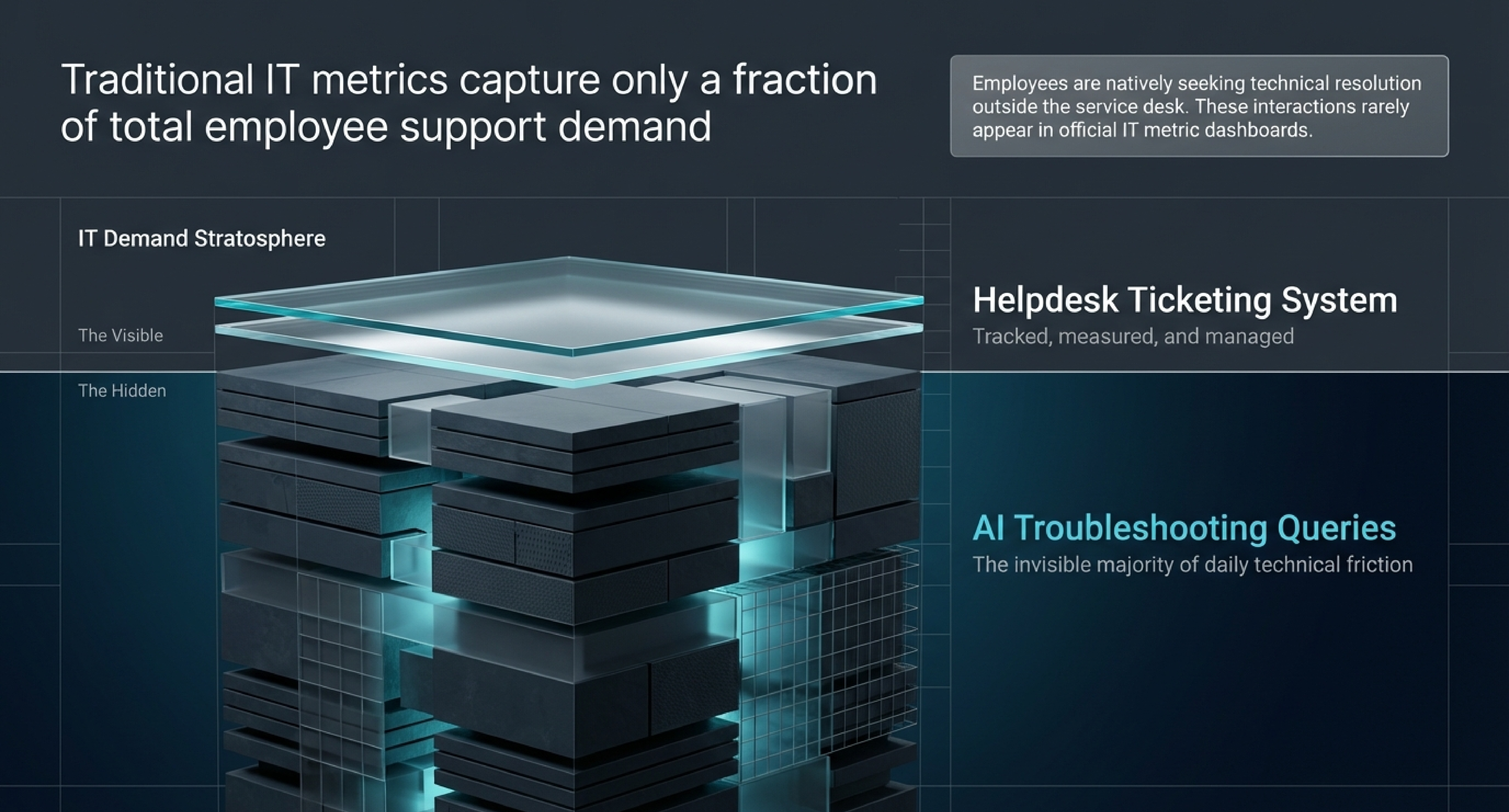
For CIOs and technology leaders, this shift is not just a change in user behavior—it is a critical revelation of Hidden IT Debt. By analyzing how the workforce interacts with AI, organizations can finally gain visibility into the "micro-frictions" that drain productivity and impact IT ROI.
--------------------------------------------------------------------------------
1. The Power of 85.5 Million Data Points: Understanding the Shift
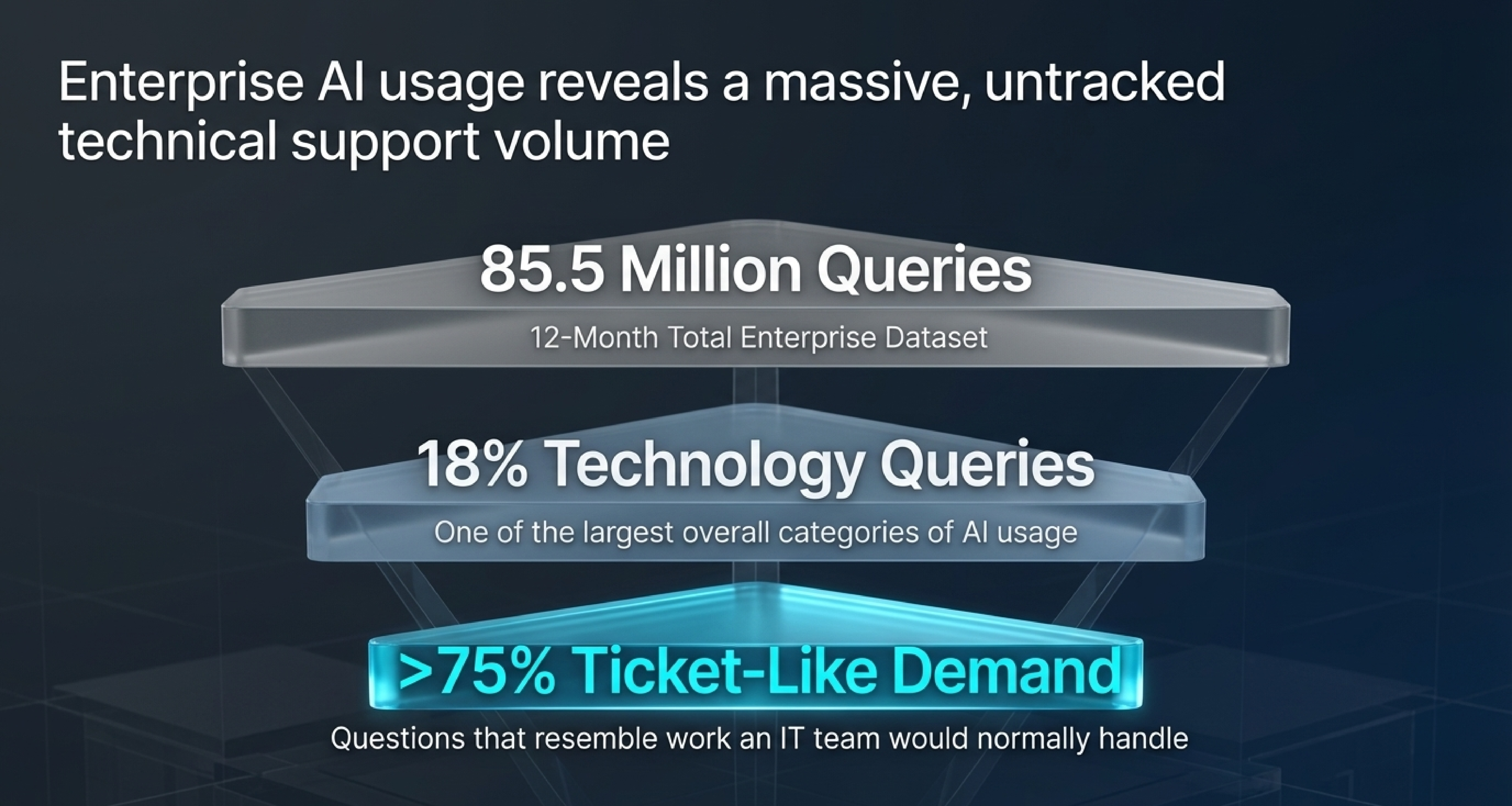
To grasp the scale of this transformation, we must look at the data. An extensive analysis of 85.5 million Perplexity Enterprise queries over a twelve-month period has provided an unprecedented window into the daily technical struggles of the modern workforce. This study represents one of the largest datasets ever compiled regarding how employees use AI to navigate their professional environments.
The findings suggest that AI is no longer a peripheral tool for creative writing or general search; it has become a central nervous system for technical troubleshooting. As software ecosystems become more fragmented, the "time-to-resolution" offered by a search-based AI often outperforms the standard "wait-and-response" cycle of a traditional IT ticket.
2. The 18% Factor: Why Technology Inquiries Dominate AI Usage
One of the most striking insights from the research is that technology-focused inquiries have emerged as one of the largest and most consistent categories of enterprise AI usage. Specifically, these technical questions account for 18% of all enterprise AI queries within the analyzed dataset.
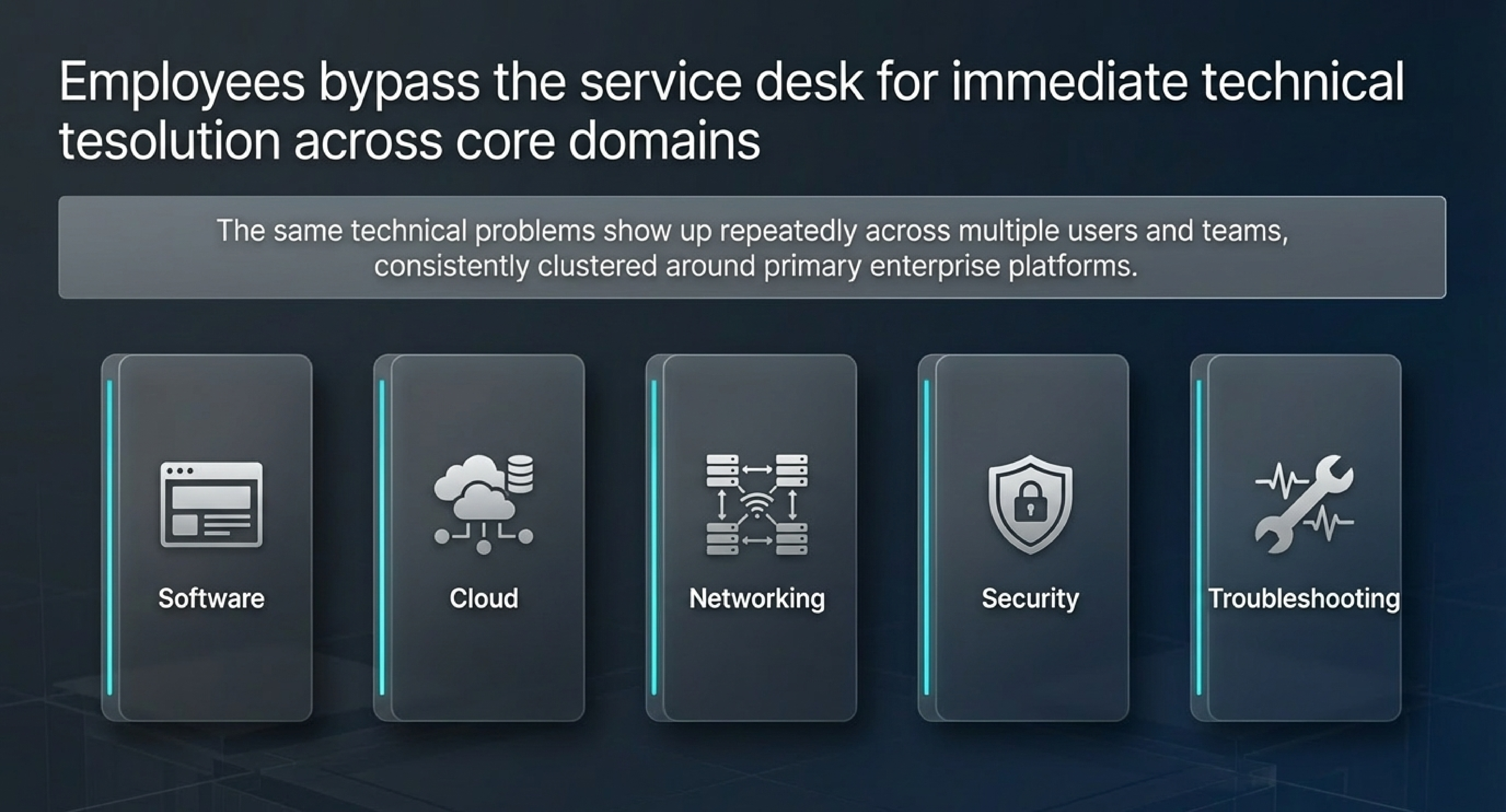
This consistent demand signals a fundamental gap in how employees interact with company-provided tools. The queries generally fall into five high-stakes categories:
Software and Cloud Management: Navigating complex SaaS interfaces and cloud configurations.
Networking and Connectivity: Resolving VPN, Wi-Fi, and internal access hurdles.
Cybersecurity and Security Protocols: Seeking real-time clarification on compliance and safety measures.
Troubleshooting and Error Resolution: Diagnosing specific technical failures that halt productivity.
3. The "Ticket-Like" Nature of the AI Interface
The research reveals that the nature of these queries is highly specific. More than three out of four (75%+) of these technology-focused AI questions resemble the exact type of work an IT team would normally handle as a formal ticket.
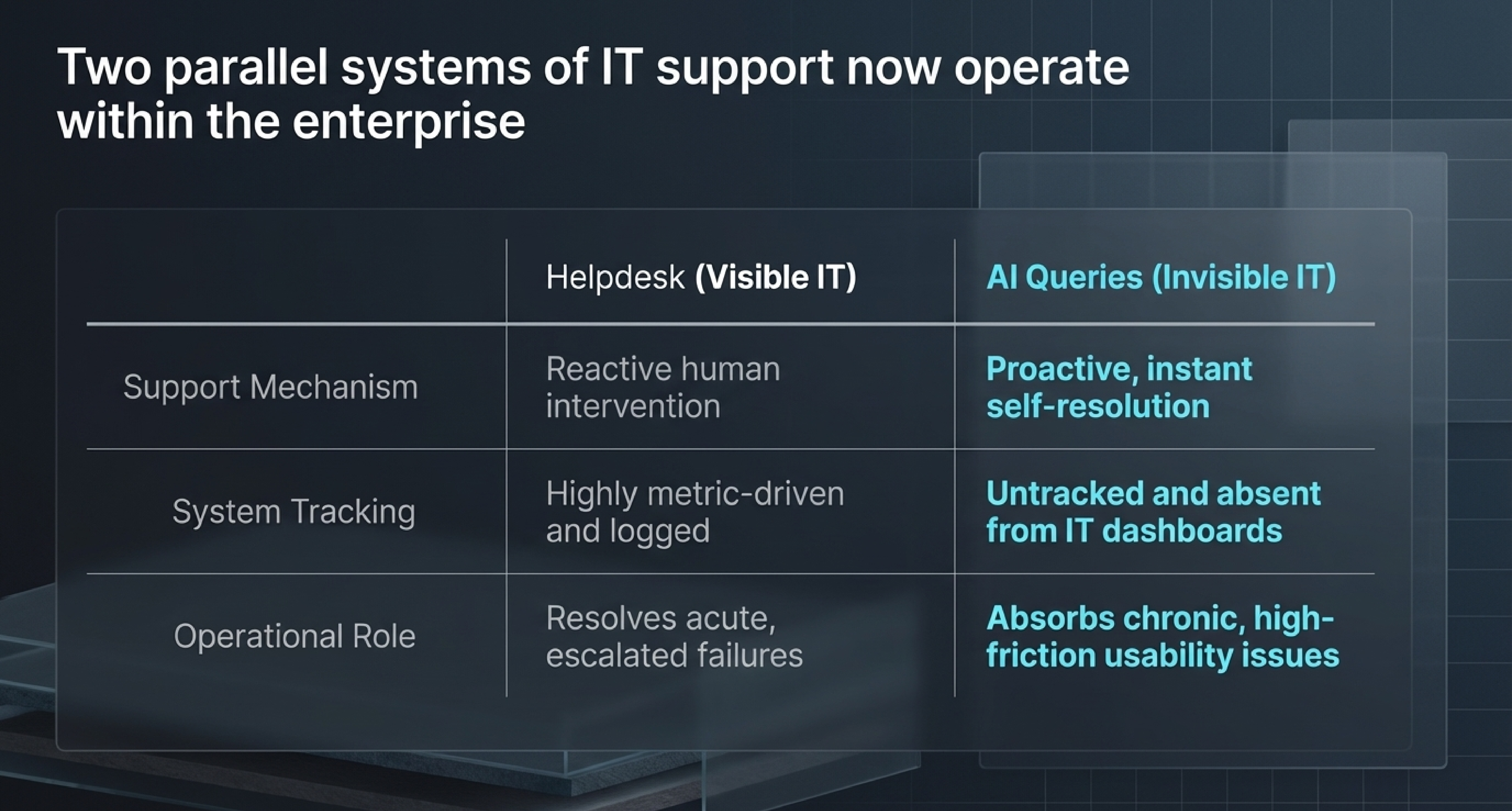
These are not merely general interest questions. They are "live" technical problems that happen outside the view of the formal service desk. Because these interactions occur within private AI interfaces, they rarely—if ever—appear in IT metrics or performance reports. This creates a "data blind spot" where a massive amount of technical friction remains invisible to the people responsible for fixing the root causes.
--------------------------------------------------------------------------------
4. The $300 Million Economic Impact of "Shadow Support"
The financial implications of this invisible support load are staggering. Under conservative assumptions, the research estimates that this hidden volume represents approximately $300 million in annual ticket-equivalent IT effort across the organizations analyzed.
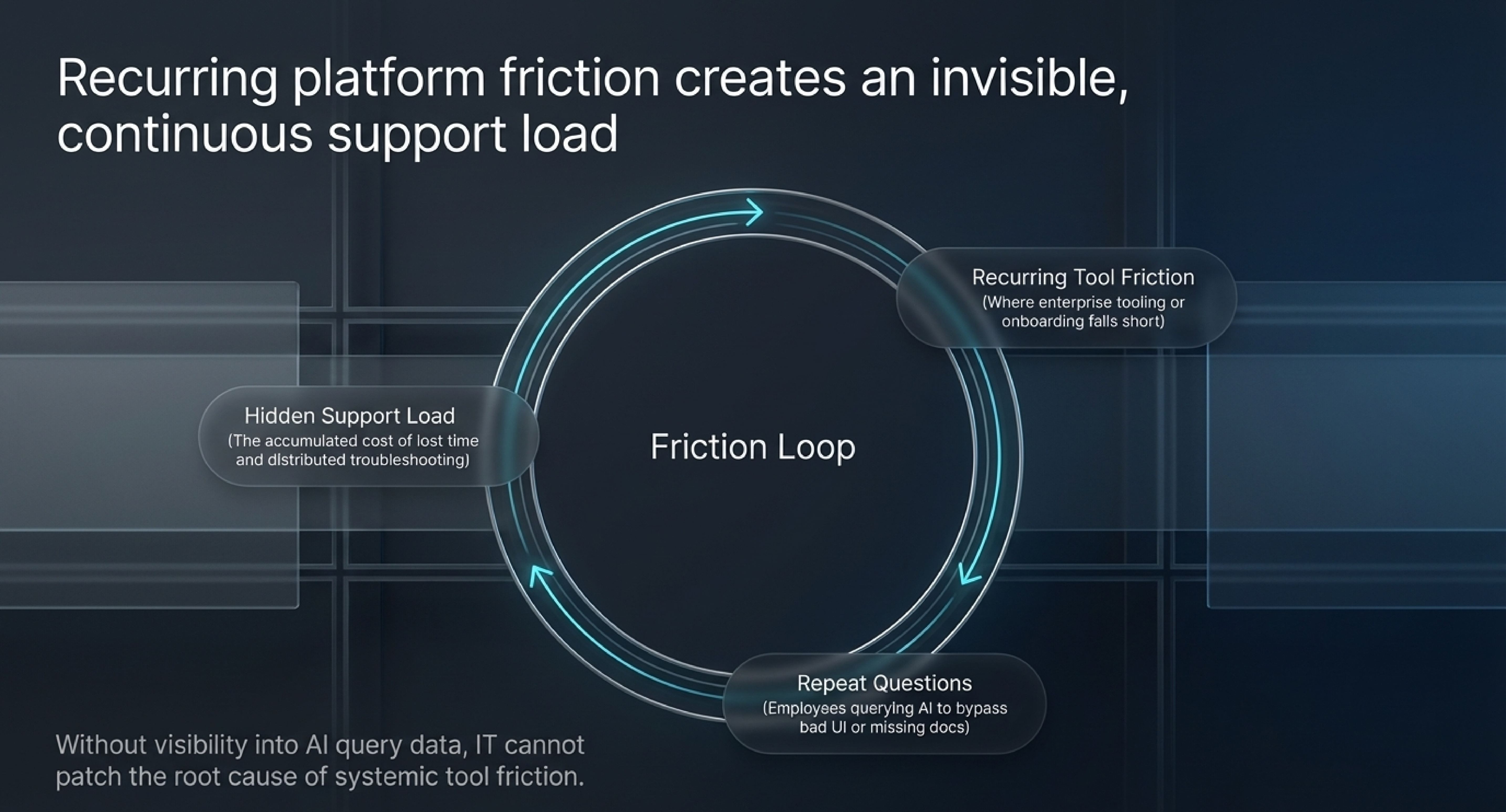
This $300 million figure represents Hidden IT Debt. When employees use AI to solve problems that should have been addressed by better software design, clearer documentation, or more effective onboarding, it represents a "lost" cost. This effort masks the true operational expense of the IT department, leading to an inaccurate understanding of Enterprise ROI and organizational efficiency.
5. External Research: The Rise of "Digital Friction"
(Information in this section is based on general industry trends regarding digital friction and is not derived directly from the provided sources). To put the $300 million figure into context, external market research suggests that the average employee loses significant time each week simply switching between apps or trying to find information.
This is often referred to as "Digital Friction." As organizations add more tools to their tech stack, the "Cognitive Load" on employees increases. In this environment, AI acts as a "Cognitive Layer" that helps employees manage the complexity that the IT department has deployed but perhaps hasn't fully optimized.
--------------------------------------------------------------------------------
6. AI as a "First-Class" Live Signal for IT Intelligence
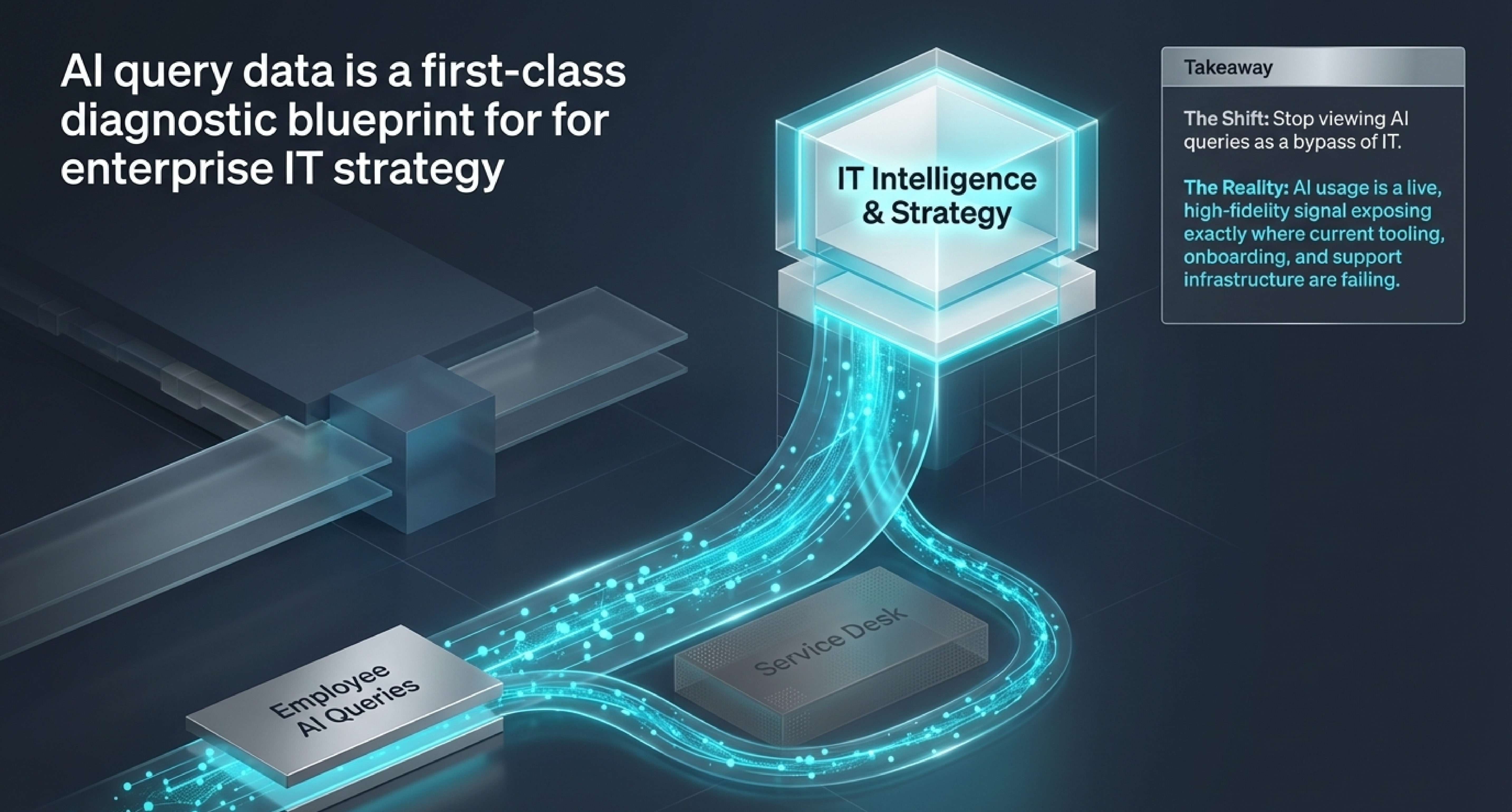
The sources argue for a fundamental shift in leadership strategy: AI query data should be treated as a "first-class source of IT intelligence". Unlike traditional ticket systems, which are reactive and often capture only the most frustrated users, AI query data acts as a "live signal".
This real-time data stream offers a diagnostic window into three critical areas of the enterprise:
Tooling Efficacy: If thousands of employees are asking AI how to perform a basic function in a specific enterprise platform, it is a clear signal that the platform is either too complex or poorly integrated.
Onboarding Deficiencies: High volumes of technical queries from new cohorts suggest that initial training programs are failing to provide employees with the foundational knowledge they need.
Support Gaps: When AI becomes the primary source for troubleshooting, it reveals that internal knowledge bases are either outdated, difficult to search, or non-existent.
7. Identifying Recurring Friction Across Teams
A major revelation of the analysis is that the same problems show up repeatedly across different users and teams. These issues are often centered around the same enterprise platforms that organizations rely on most for their core business functions.
By identifying these clusters of "repeat questions," IT departments can move from a reactive posture (fixing tickets) to a proactive strategy (fixing the system). Instead of answering the same question 1,000 times through a help desk, the IT team can use AI data to identify the flaw in the software or the gap in the documentation and fix it at the source.
--------------------------------------------------------------------------------
8. Strategy for the Future: Reclaiming the Data
To turn this $300 million debt into a strategic advantage, CIOs must move toward a model of AI-Driven IT Support. This involves:
Analyzing Query Patterns: Periodically reviewing anonymized AI query themes to identify which tools are causing the most friction.
Optimizing the Knowledge Base: Using the most frequent AI questions to update internal FAQs and help articles.
Rationalizing the Tech Stack: Identifying tools that require excessive "shadow support" and evaluating if they should be replaced with more intuitive alternatives.
Conclusion: Turning Invisible Costs into Visible ROI
The revealed $300 million hidden IT effort is both a challenge and an opportunity. While it highlights a massive amount of "lost" productivity, it also provides the map needed to fix it. Organizations that embrace AI query data as a live signal of organizational health will be able to build a more resilient, efficient, and user-friendly technical infrastructure.
The goal of integrating Generative AI is not just to replace tasks, but to gain the intelligence necessary to build a better enterprise. By acknowledging the "hidden support load," leaders can finally align their IT resources with the actual needs of their workforce, turning invisible data into actionable IT Intelligence.
--------------------------------------------------------------------------------
SEO Summary & Trending Keywords
Primary Keywords: Enterprise AI Strategy, Hidden IT Support Costs, IT ROI Optimization, Digital Transformation 2026, IT Intelligence Data, Perplexity Enterprise Research, Shadow IT Trends, IT Service Management (ITSM) Evolution, AI-Driven Troubleshooting.
Secondary Keywords: Technical Friction, Cloud Management, Cybersecurity Compliance, SaaS Integration Challenges, Employee Productivity AI, Technical Ticket Volume, CIO Leadership Strategy, Digital Onboarding.
Meta Description: Discover how 85.5 million AI queries revealed a $300 million hidden IT debt. Learn how CIOs can use AI query data as a "live signal" to identify failing tools, improve onboarding, and maximize IT ROI. (Note: The external research and SEO sections were added to enhance the article's depth and searchability as requested and are not derived from the primary source text).
Sources Used
"Economic Impacts of AI on Enterprise IT Organizations" - Section: resources, research & guides.
"Economic Impacts of AI on Enterprise IT Organizations" - Section: Summary of AI query behavior and hidden IT volume.
"Economic Impacts of AI on Enterprise IT Organizations" - Section: Economic impact figures ($300M) and IT intelligence arguments.
"Economic Impacts of AI on Enterprise IT Organizations" - Product and Company Overview.
This editorial is produced for informational purpose. All figures sourced from publicly available records as of early 2026.
For more important updates and curated information on regular basis, Join our whatsapp community : https://chat.whatsapp.com/DfkQi7r4o4dDduWvYor9dk
Like this article? Share it with your friends


