


Government Just Signed an MoU With This AI Startup
What Exactly Is a "Proof of Skill" Platform?
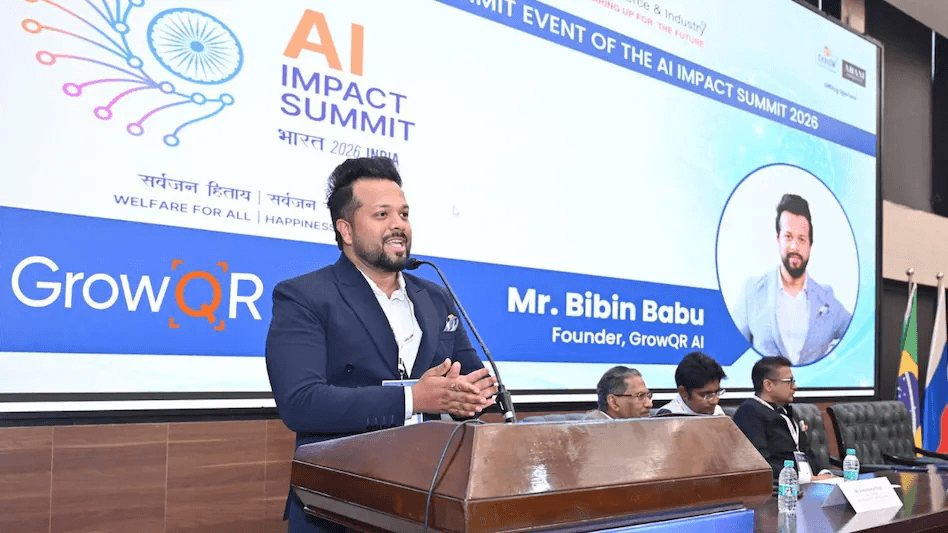
GrowQR.ai is building verifiable, AI-assessed skill credentials for India's workforce — starting with tier-2 cities and state government partnerships. It's a bet that the hiring crisis isn't about talent; it's about trust.
India produces roughly 1.5 million engineering graduates annually. Employers routinely say 70–80% of them are not "industry-ready." Both things are true simultaneously — and the gap between them is not primarily a teaching problem. It is a measurement problem. GrowQR.ai is building the infrastructure to measure it properly, starting from the cities that the Bengaluru startup ecosystem usually forgets.
The Bihar government's Global Competitiveness Centre recently signed a Memorandum of Understanding with a startup most people in the tech press hadn't heard of. The MoU was for deploying GrowQR.ai's proof-of-skill platform across government skilling programmes — a bet that AI-assessed credentials could provide the kind of verifiable, employer-trusted skill signal that paper certificates and rote-training assessments have consistently failed to deliver. Patna signed the paper. Delhi NCR, Visakhapatnam, and several industry partners were already in conversation.
The phrase "proof of skill" is worth unpacking, because it's the kind of jargon that either means something specific or means nothing at all. In GrowQR's framing, it means a credential that is AI-assessed (not self-reported), verifiable by employers (not just held by candidates), and structured around demonstrated output rather than course completion. The QR in the company name is literal: each credential is tied to a scannable, tamper-evident digital verification system.
Think of it as the difference between a gym membership and a fitness test. A certificate from a coding bootcamp tells you someone paid attention for six weeks. A proof-of-skill credential tells you they can actually debug a React application under timed conditions. The latter requires assessment infrastructure — AI-driven, scalable, and resistant to gaming — that most edtech companies have not bothered to build because building it is hard.
BiharGCC MoU signed
3Cities in rollout: Vizag, Patna, Delhi NCR
AIAssessed, not self-reported
QRVerifiable employer-scan credentials
The Skills Gap Is Actually a Trust Gap
India's hiring problem looks like a mismatch — too many candidates, not enough skilled ones — but the underlying dynamics are more subtle. The actual failure is informational. Employers can't cheaply distinguish between a candidate who genuinely knows Python and one who memorised the keywords for a phone screen. Candidates can't cheaply signal genuine competence to employers they don't have personal access to. The result is expensive hiring processes, high early attrition, and a persistent "freshers aren't hireable" sentiment that has become a self-fulfilling prophecy.
This is the problem that credential infrastructure is designed to solve. Blockchain-based credentials, AI-proctored assessments, and verified skill profiles are all attempts to reduce the information asymmetry between candidates and employers. GrowQR's specific approach — AI assessment, QR-verifiable output, government partnership for scale — positions it as a B2G and B2B play rather than a direct-to-candidate consumer product.
"The Indian hiring market doesn't have a talent shortage. It has a verification shortage. The candidate who can prove their skills to a distant employer has an enormous advantage — and most can't."
Why Start in Bihar and Visakhapatnam?
The founder thesis — Bibin Babu and Pranav Prashar — is that tier-2 and tier-3 India is where the skills problem is most acute and where the established players are least present. Bengaluru-based HRTech companies build for Bengaluru employers. The candidate in Patna or Nellore who has acquired a genuine skill through online learning has no trusted way to signal that skill to an employer 1,500 kilometres away.
Government partnerships in states like Bihar provide both scale (thousands of skilling programme beneficiaries) and legitimacy (a state government stamp on the credential framework). The Bihar GCC MoU is not just a revenue deal — it's a distribution play. If GrowQR's credentials become the standard output of a state skilling programme, employers across India who want to hire from that pool have a reason to accept them.
This is a smart go-to-market strategy that resembles how Aadhaar scaled: partner with government for initial distribution, build employer acceptance as a second phase, then monetise the network. It is slow and requires navigating government procurement complexity, but the moat it builds — institutional trust at the government level — is difficult for a private competitor to replicate.
The GovTech Play: Opportunity and Risk
Government partnerships for EdTech and SkillTech companies in India have a mixed track record. The PMKVY (Pradhan Mantri Kaushal Vikas Yojana) scheme produced millions of trained workers, many of whom found that their certificates opened no doors. The incentive structures in government skilling programmes can prioritise enrollment numbers over placement outcomes. If GrowQR's credentials get embedded in a programme with poor placement follow-through, the credential itself suffers reputational contamination regardless of its technical quality.
The founders appear aware of this risk — the Bihar GCC (Global Competitiveness Centre) partnership is specifically with an economic development body focused on employment outcomes, not just training completion. That's a more promising institutional partner than a generic skilling ministry. But the proof will be in placement data, and that data isn't public yet.
⚠ Honest Risk Assessment
▲Government dependency risk: MoUs can take 18-36 months to convert into actual deployments and revenue. Government procurement timelines are notoriously unpredictable, and political changes can shelve signed agreements entirely.
▲Employer acceptance chicken-and-egg: Credentials are only valuable when employers trust them. Building employer acceptance requires a critical mass of credential-holders — which requires employer acceptance first. Breaking this loop is the hardest part of the business.
▲Competition from incumbents: NSDC, Nasscom FutureSkills, and HRTech players like Mettl and iMocha are already in the assessment space. GrowQR needs to differentiate beyond technology — likely through the government distribution channel.
▲Revenue model opacity: The public profile of GrowQR's monetisation — pricing, enterprise deals, revenue — is limited. For a startup pursuing government scale, early revenue visibility matters for investor confidence.
Frequently Asked Questions
What is a "proof-of-skill" credential and how is it different from a certificate?
A traditional certificate confirms course completion. A proof-of-skill credential confirms demonstrated competence — assessed by AI under controlled conditions, not self-reported. GrowQR's credentials are tied to QR-verifiable digital records that employers can independently scan and confirm, making them harder to fake and more trusted than conventional paper certificates.
Who are GrowQR.ai's founders?
GrowQR.ai was founded by Bibin Babu and Pranav Prashar, who serves as co-founder and CTO. The team is focused on building AI-driven assessment infrastructure for India's workforce development ecosystem.
What is the Bihar GCC MoU?
Bihar's Global Competitiveness Centre is a state government body focused on employment and economic development. Their MoU with GrowQR.ai involves deploying the proof-of-skill platform within state skilling programmes — creating a government-backed distribution channel for GrowQR's credential infrastructure.
Which cities is GrowQR.ai currently active in?
GrowQR.ai has announced rollouts in Visakhapatnam, Patna, and Delhi NCR — a deliberate tier-2 and government-partnered geography that reflects the company's thesis about where skill verification infrastructure is most needed and least present.
Editorial Verdict
Structurally Smart. Execution-Stage Critical.
The problem GrowQR.ai is tackling — India's trust gap between skilled candidates and distant employers — is real, large, and underserved in tier-2 cities. The go-to-market via government partnerships is structurally intelligent: it provides scale, legitimacy, and distribution that a B2C consumer play would take years to build organically.
The risks are real too: government partnership timelines are unpredictable, employer acceptance requires a cold-start breakthrough, and incumbent HRTech players have entrenched enterprise relationships. GrowQR is at the stage where the thesis is sound but the execution data is still forming. The Bihar MoU is a genuine signal of traction — not a proof of business model, but a credible indication that the institutional market takes the idea seriously.
Watch how many placements the Bihar programme generates over the next 12 months. That number will tell you more about GrowQR's future than any pitch deck could.
Sources & References:
GrowQR.ai official website and LinkedIn · Bihar Global Competitiveness Centre · India Skills Report 2024 (Wheebox) · NSDC skilling programme statistics · PMKVY programme data, Ministry of Skill Development · Published research on AI-based credential systems
This editorial is produced for informational and SEO content purposes. All figures sourced from publicly available records as of early 2026.
For more important updates and curated information on regular basis, Join our whatsapp community : https://chat.whatsapp.com/DfkQi7r4o4dDduWvYor9dk
Like this article? Share it with your friends


