

From Budget Kings to Electric Dreams by Honda
5 things you didn't know about Honda's boldest India roadmap, from a silent Activa revolution to a ₹43-lakh touring legend.
In India, a Honda isn't just a vehicle, it's a generational handshake. From the Activa that taught a teenager to ride, to the trusty Shine ferrying a grandfather to the market, three generations of "Honda stories" live under the same roof. But as 2026 unfolds, Honda Motorcycle and Scooter India (HMSI) is rewriting that story entirely, from mass-market commuter king to high-tech mobility powerhouse.
The Activa Electric Revolution:
Honda's Crown Jewel Goes Silent
No product announcement in India's two-wheeler space in 2026 carries more symbolic weight than the electrification of the Activa. For over two decades, the Activa has been the definitive Indian scooter outselling every rival month after month, recording 2,54,449 units in February 2026 alone, a staggering 46% year-on-year surge.
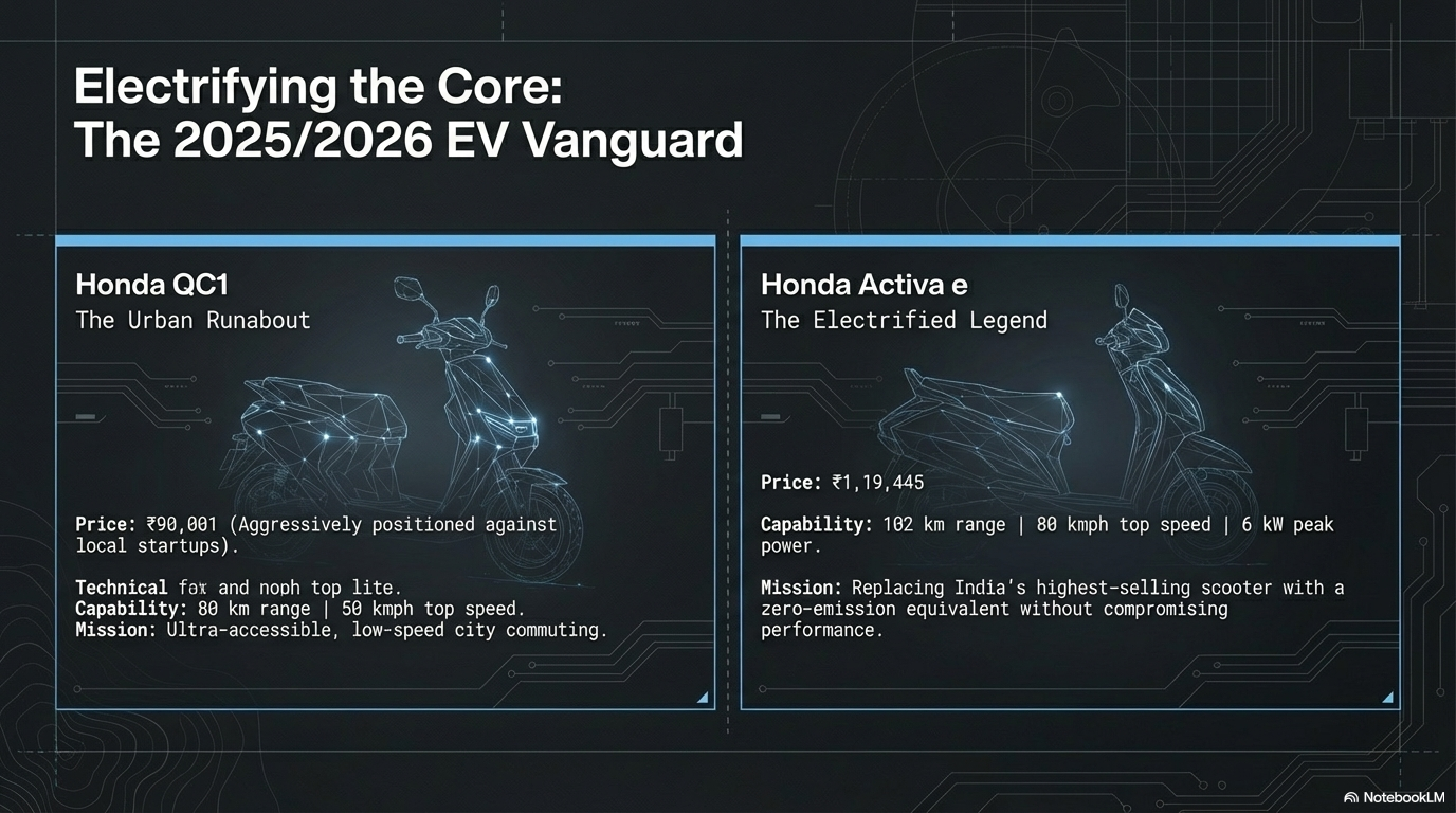
Now Honda is betting that same mass-market loyalty on electricity. The Honda Activa e: is already priced at ₹1,19,445 (ex-showroom) and features an 80 kmph top speed with a 102 km claimed IDC range serious enough numbers for the suburban commuter. Alongside it, the Honda QC1 positions as a city-focused runabout, capped at 50 kmph but offering the convenience of home charging.
Honda Activa e: — Key Specs 2026
₹1,19,445
Top Speed80 kmphRange (IDC)102 kmBattery2 × 1.5 kWh swappableChargingHonda swap networkRivalsTVS iQube, Bajaj Chetak, Ather Rizta
What's Coming Next
Honda is actively developing anew electric scooter on the J1H platform, expected by end-2026. It will feature higher localisation, improved battery range, and a full boot, addressing the key shortcomings of the Activa e: and QC1. This is the model that could finally rival TVS iQube and Bajaj Chetak head-on.
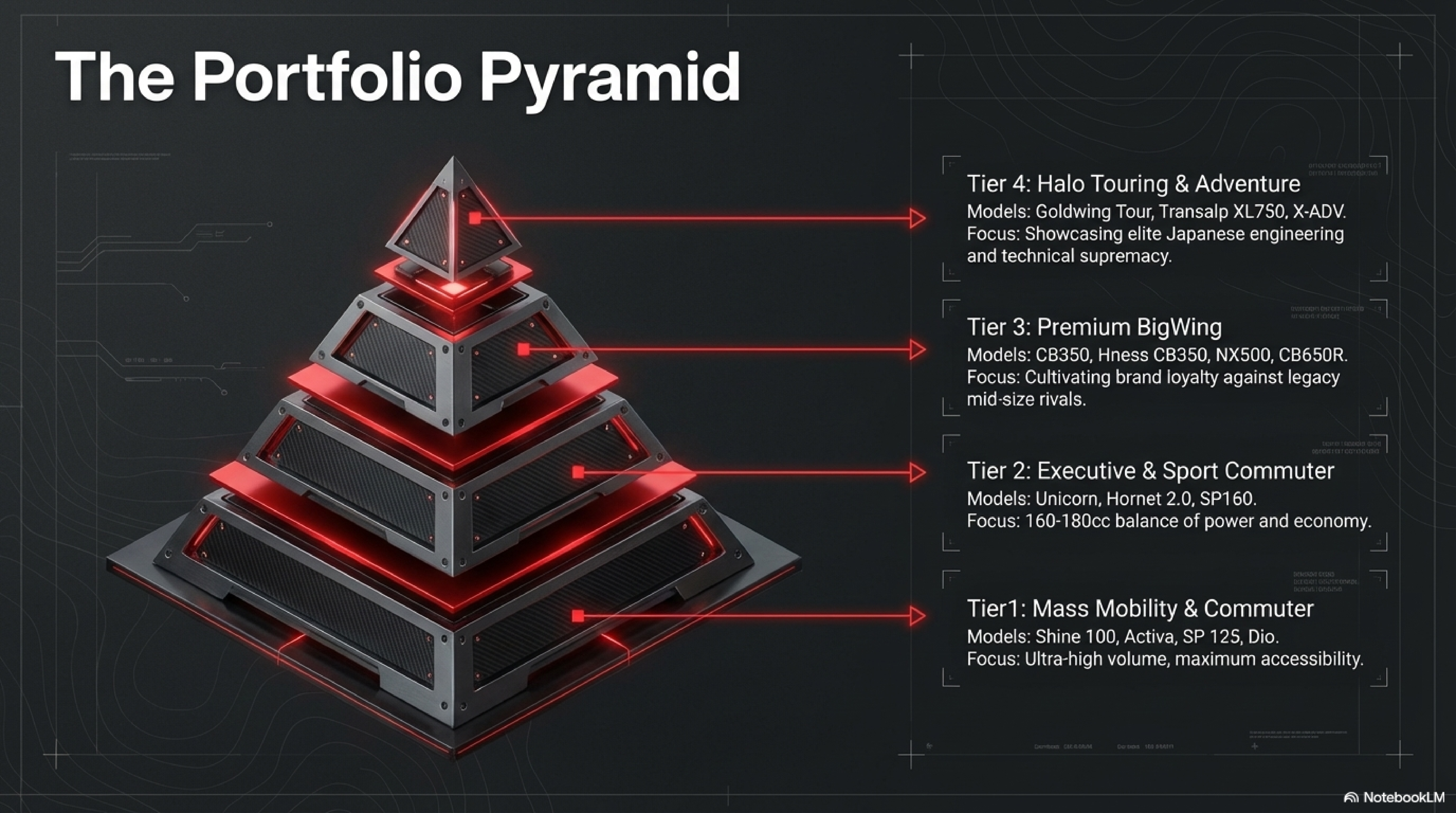
The strategy is clear: rather than one flagship EV, Honda is building a tiered portfolio an entry-level home-charger (QC1), a swap-enabled urban commuter (Activa e:), and a next-generation J1H platform model on the horizon. The Indian morning commute is about to get a lot quieter.
A Mind-Bending Price Gap:
₹65,000 to ₹43 Lakhs
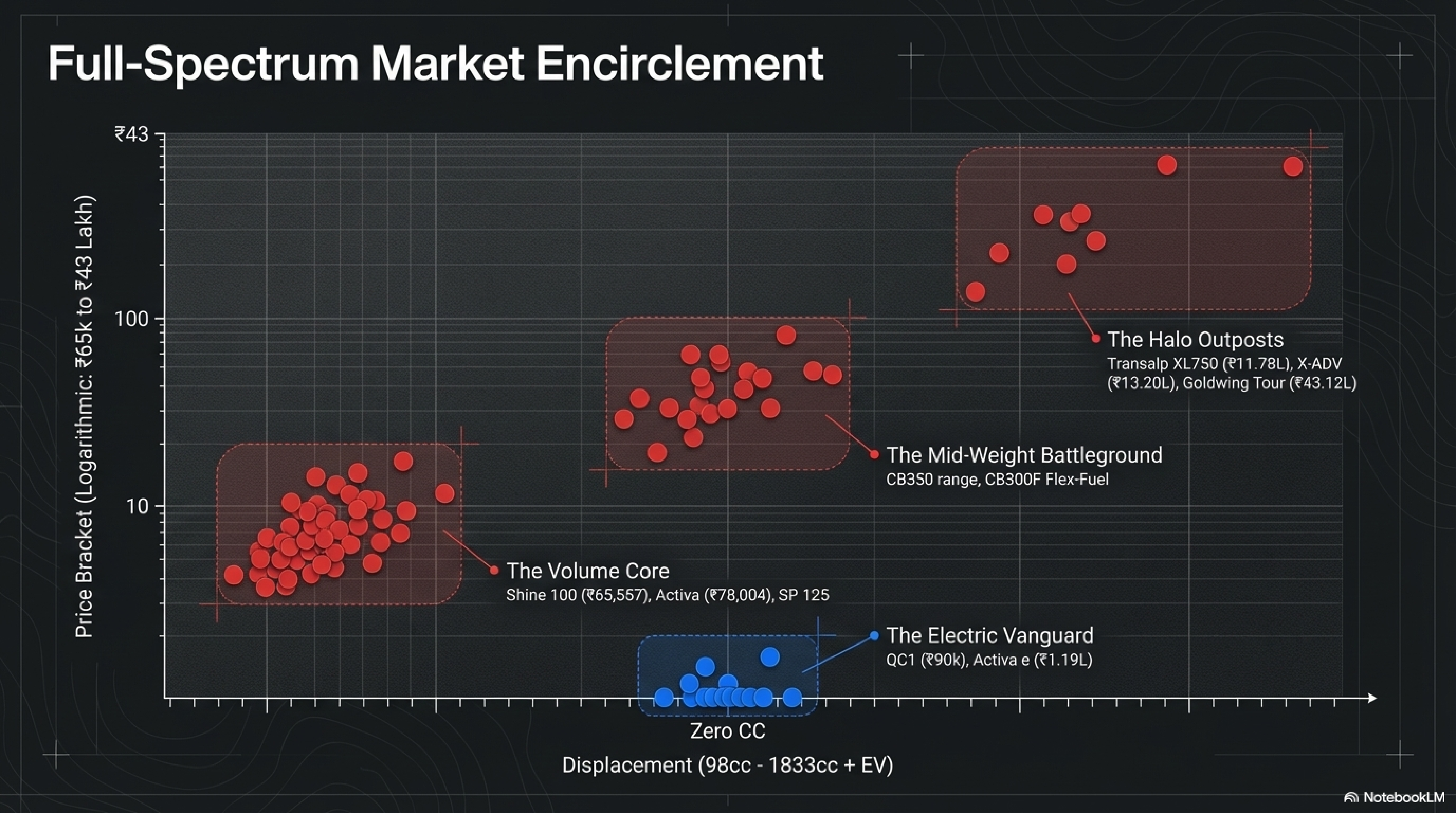
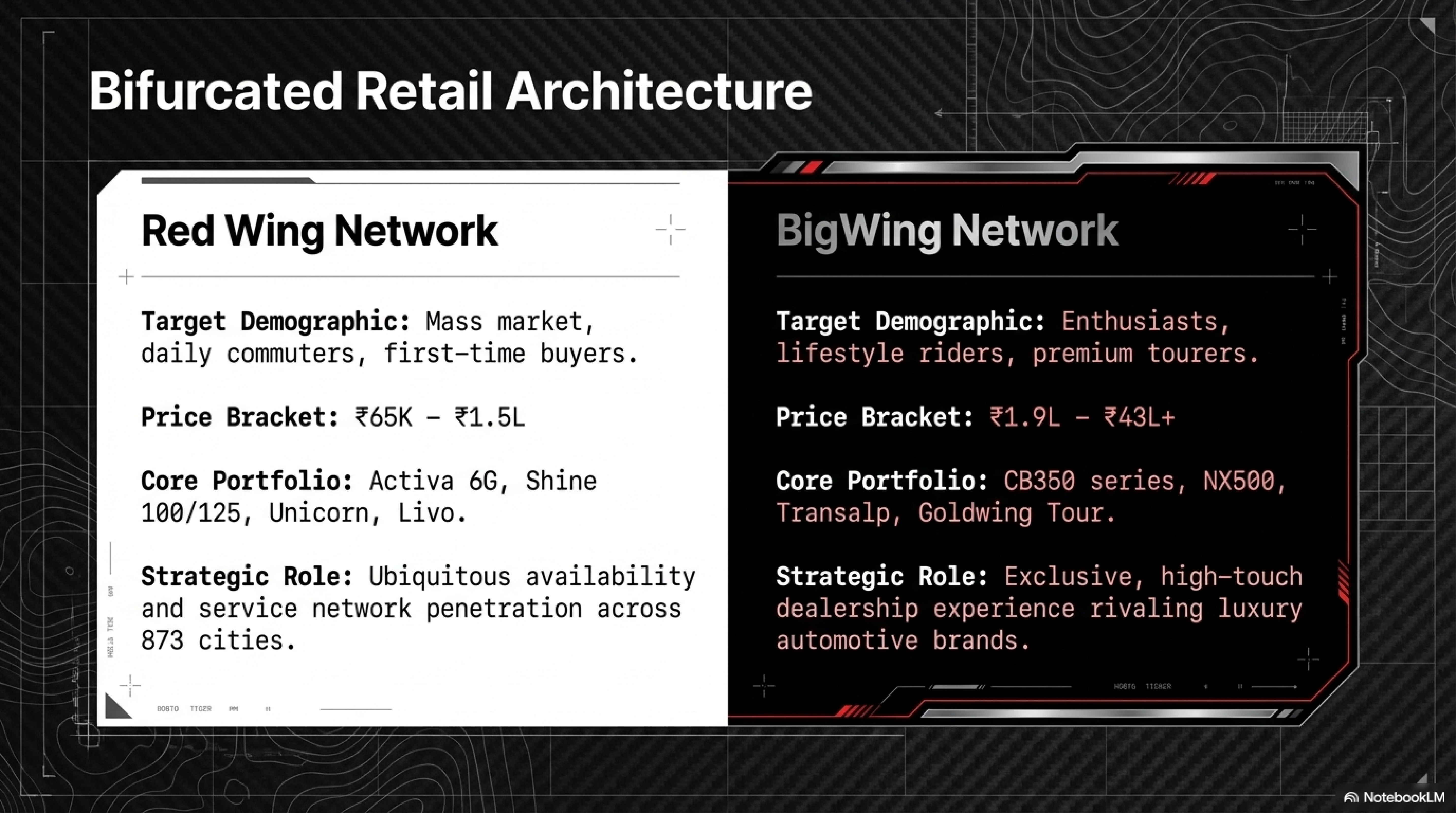
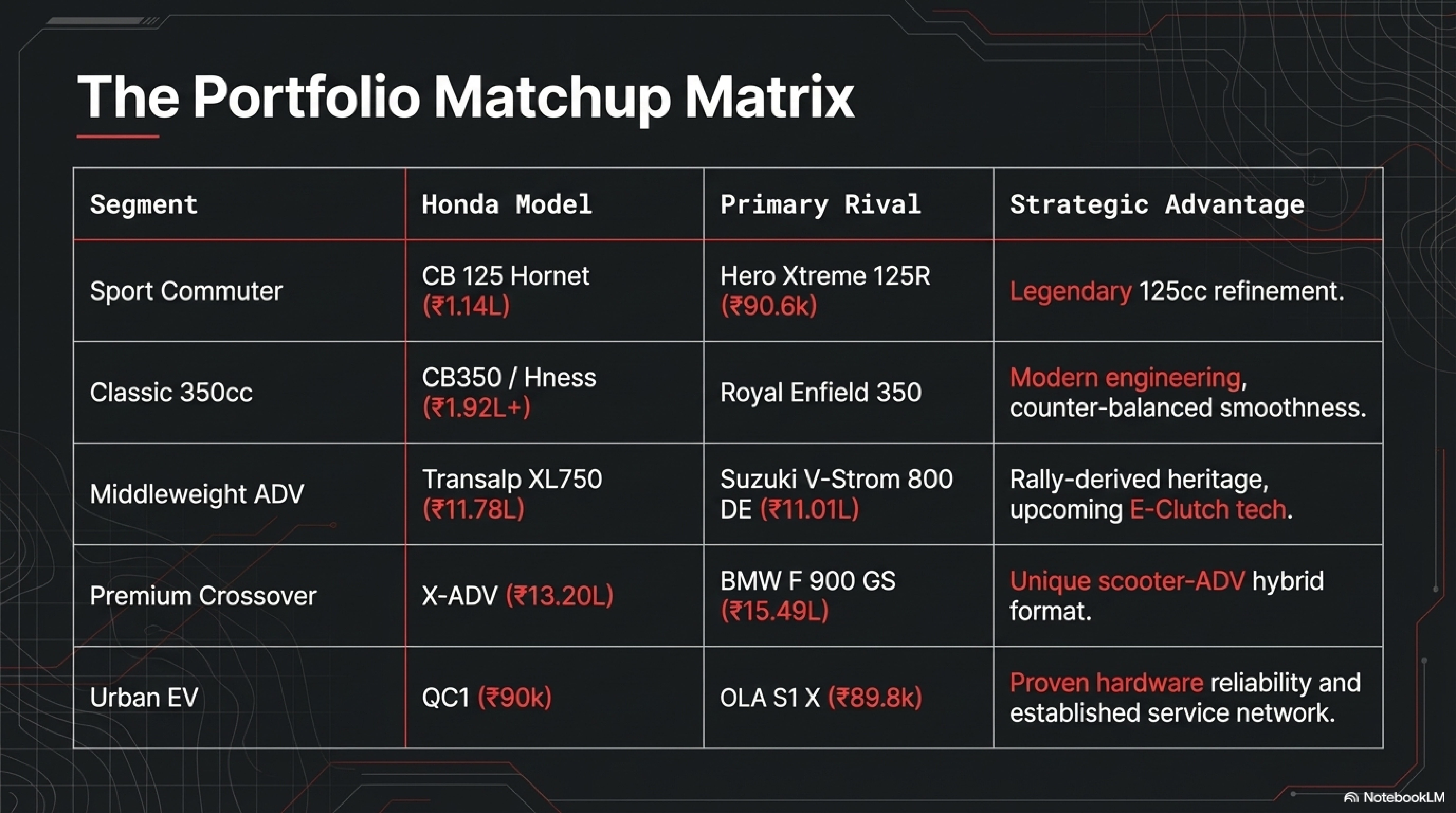
Perhaps no single chart illustrates Honda India's ambition better than its own price list. In 2026, the company simultaneously sells to a rural daily-wage worker and an ultra-high-net-worth luxury tourer — and serves both brilliantly through completely different retail channels.
Entry PointShine 100₹65,557
Honda's most accessible two-wheeler. Bulletproof reliability for the price-sensitive Indian commuter. The backbone of rural and semi-urban mobility.
The PinnacleGold Wing Tour₹43,12,654
1,833cc six-cylinder engine. 124.7 bhp. 390 kg of world-class luxury. Exclusively sold through Honda BigWing premium dealerships.
Between these poles lies Honda's new strategic middle ground: the CB300F Flex-Fuel at ₹1,55,658. This isn't just another roadster, it's Honda signalling its commitment to multiple energy futures simultaneously. Flex-fuel compatibility means the bike can run on petrol-ethanol blends up to E85, aligning perfectly with India's National Biofuel Policy push.
Gold Wing Tour — At a Glance
₹43,12,654
Engine1,833cc Flat-SixPower124.7 bhpCurb Weight390 kg
AvailabilityHonda BigWing ShowroomsSegmentUltra-Premium Touring
The 60-Million Milestone:
A Moat No Rival Can Cross
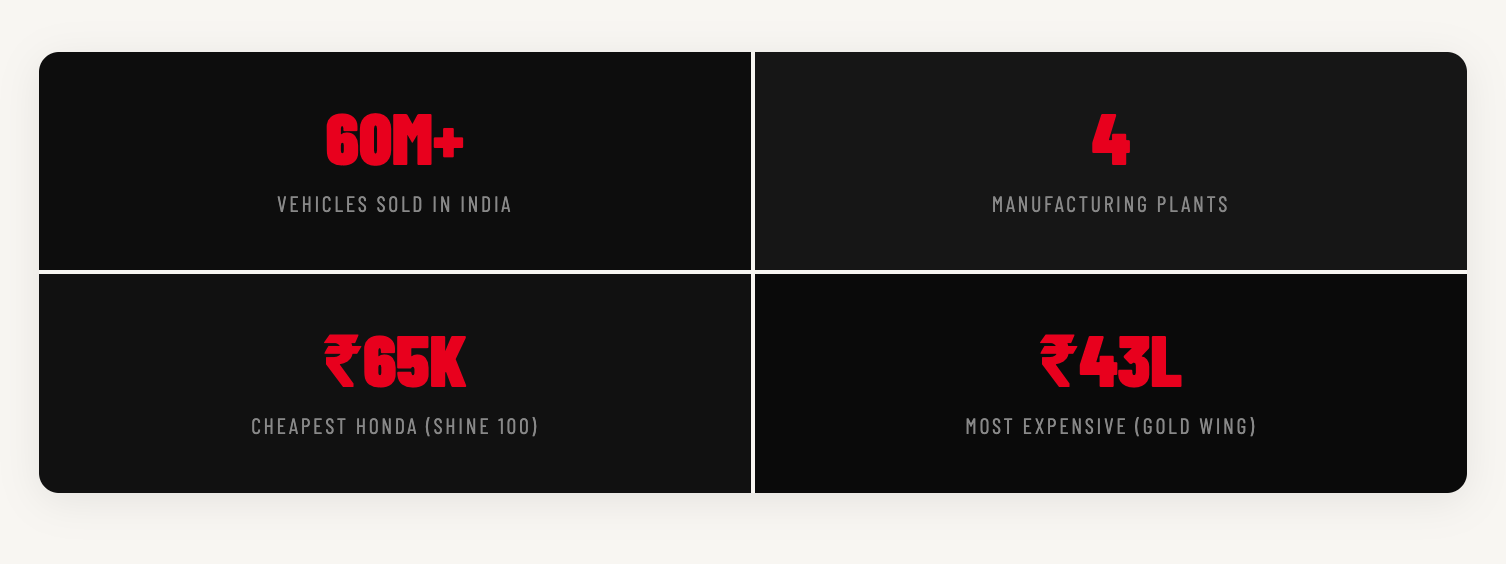
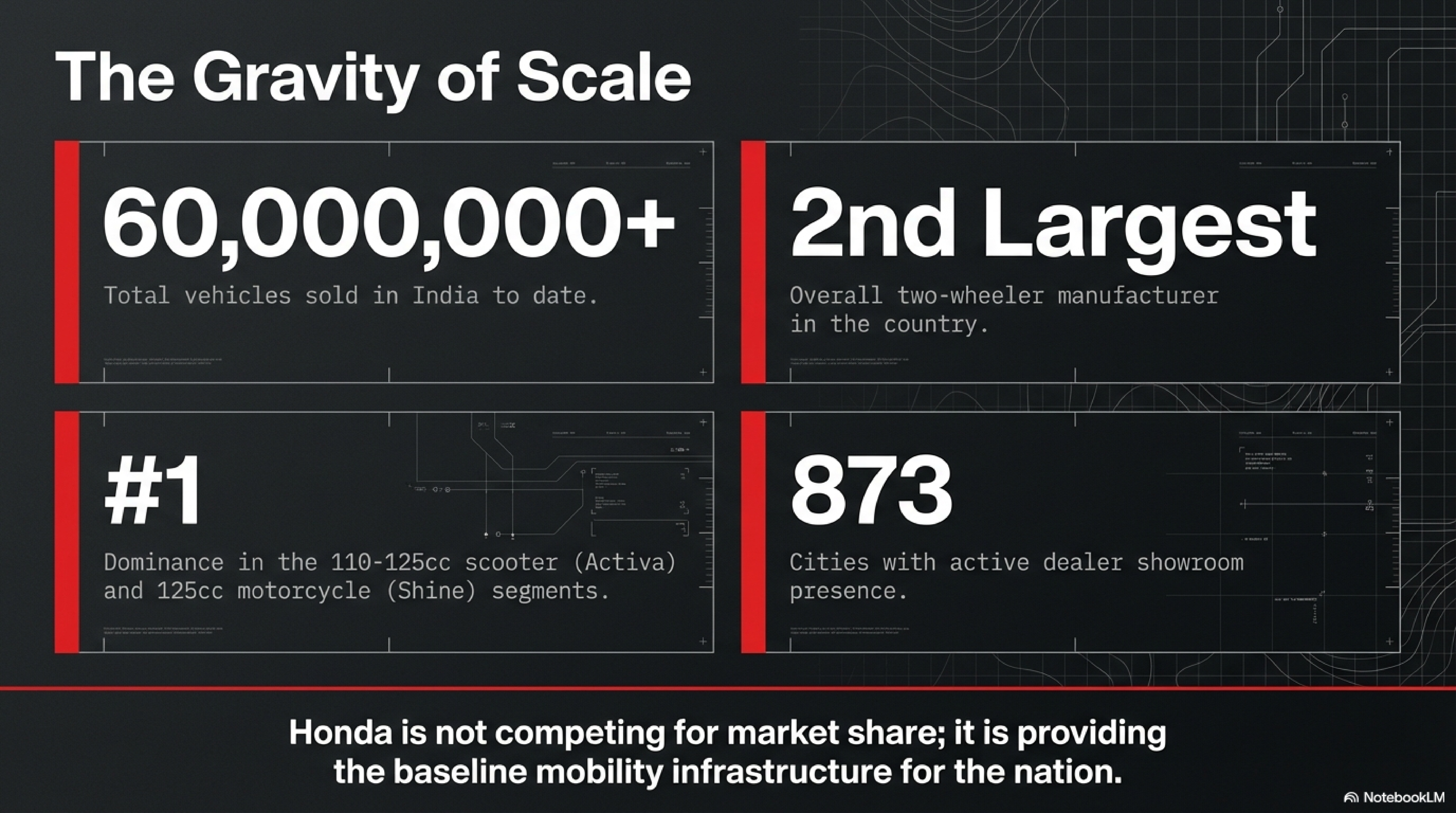
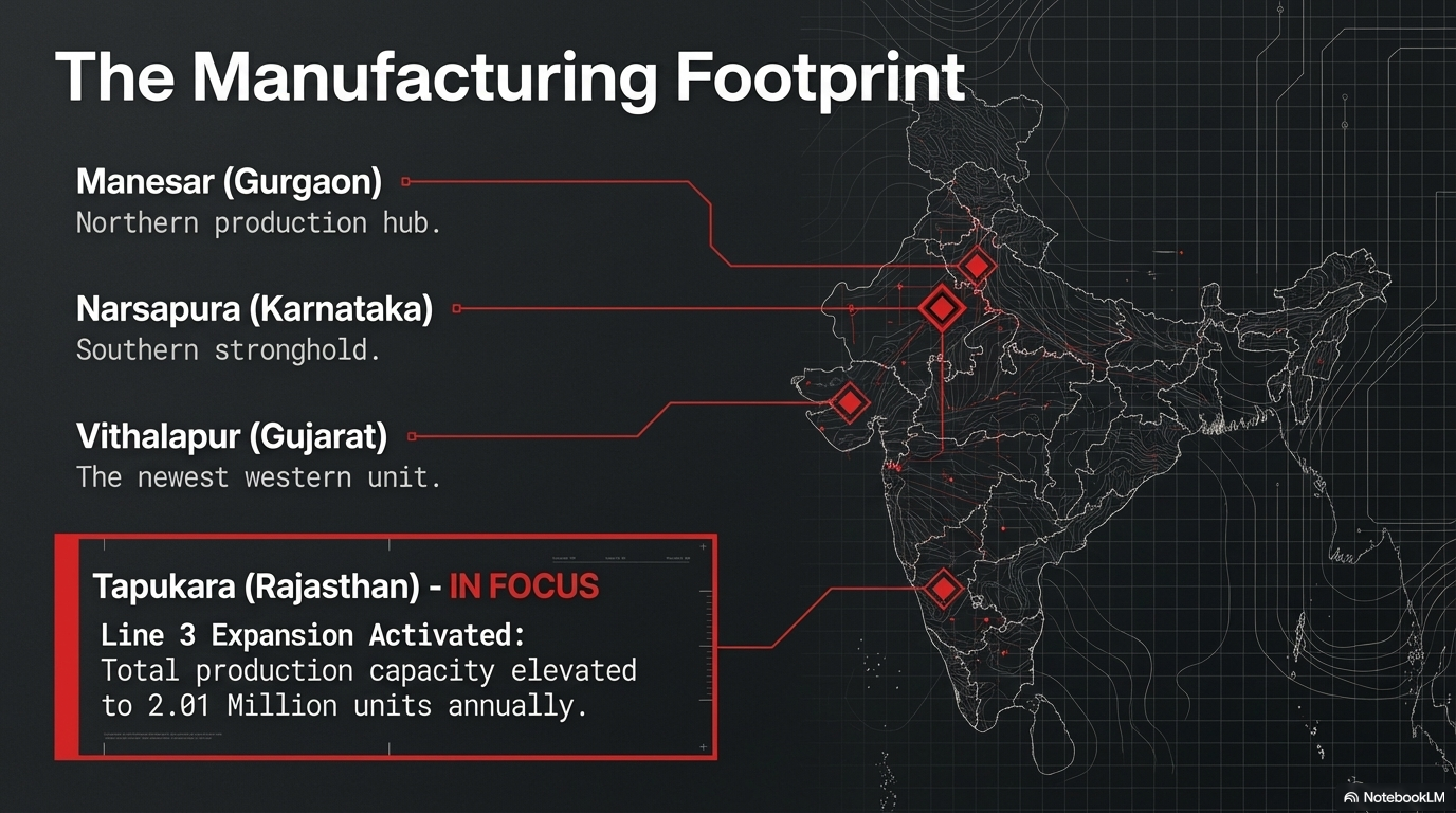
Sixty million vehicles. That number isn't just a sales record it is the single most powerful competitive advantage in India's two-wheeler industry. Honda's manufacturing infrastructure across Manesar, Narsapura, Tapukara, and Vithalapur creates a self-reinforcing flywheel: massive production scale → widespread service availability → unmatched resale value → deeper brand loyalty.
In February 2026, Honda's scooter market share alone stands at 43%+, nearly triple that of its nearest rival in the segment. HMSI has sold 25,88,233 scooters in just the first ten months of FY2026, up 6% year-on-year.
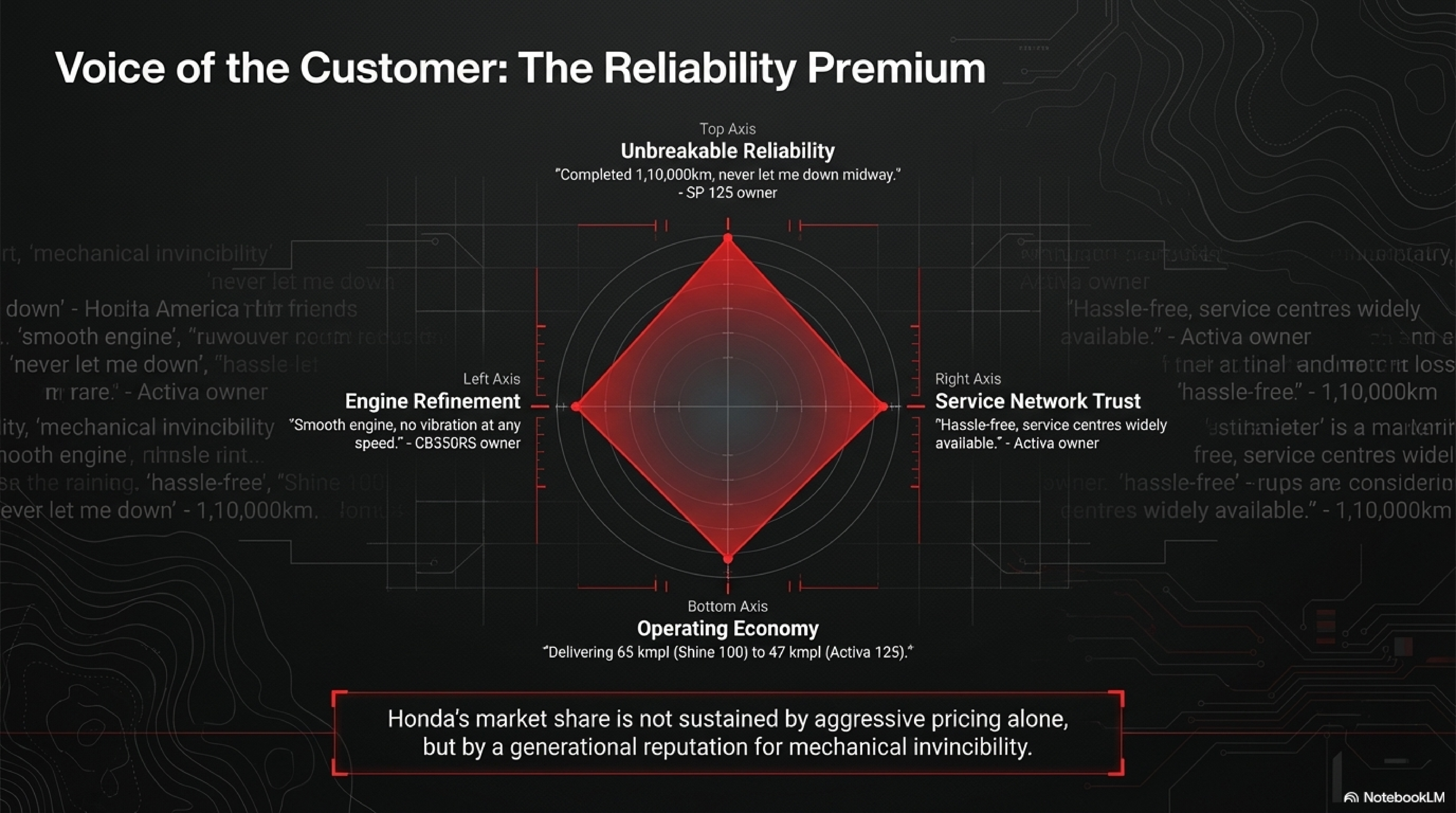
I have been driving a Honda SP 125 for more than 3 years now. Till now I have completed 1,10,000 km, and till date, this bike has never let me down midway. Honda people provide very good service at all their service centres.
— Verified Honda SP 125 Owner, India
That 1,10,000 km testimony isn't an outlier. It's the statistical expectation Honda has baked into its brand promise — and what makes the transition to EVs so high-stakes. Every electric model must eventually earn the same multigenerational trust that its petrol siblings have built over decades.
The Tapukara factory expansion to 2.01 million unit annual capacity signals that Honda isn't just defending its market position it's building the production muscle to dominate India's mobility landscape through the EV transition and beyond.
The 2026 Reorganisation:
Honda Breaks Its Own Silos
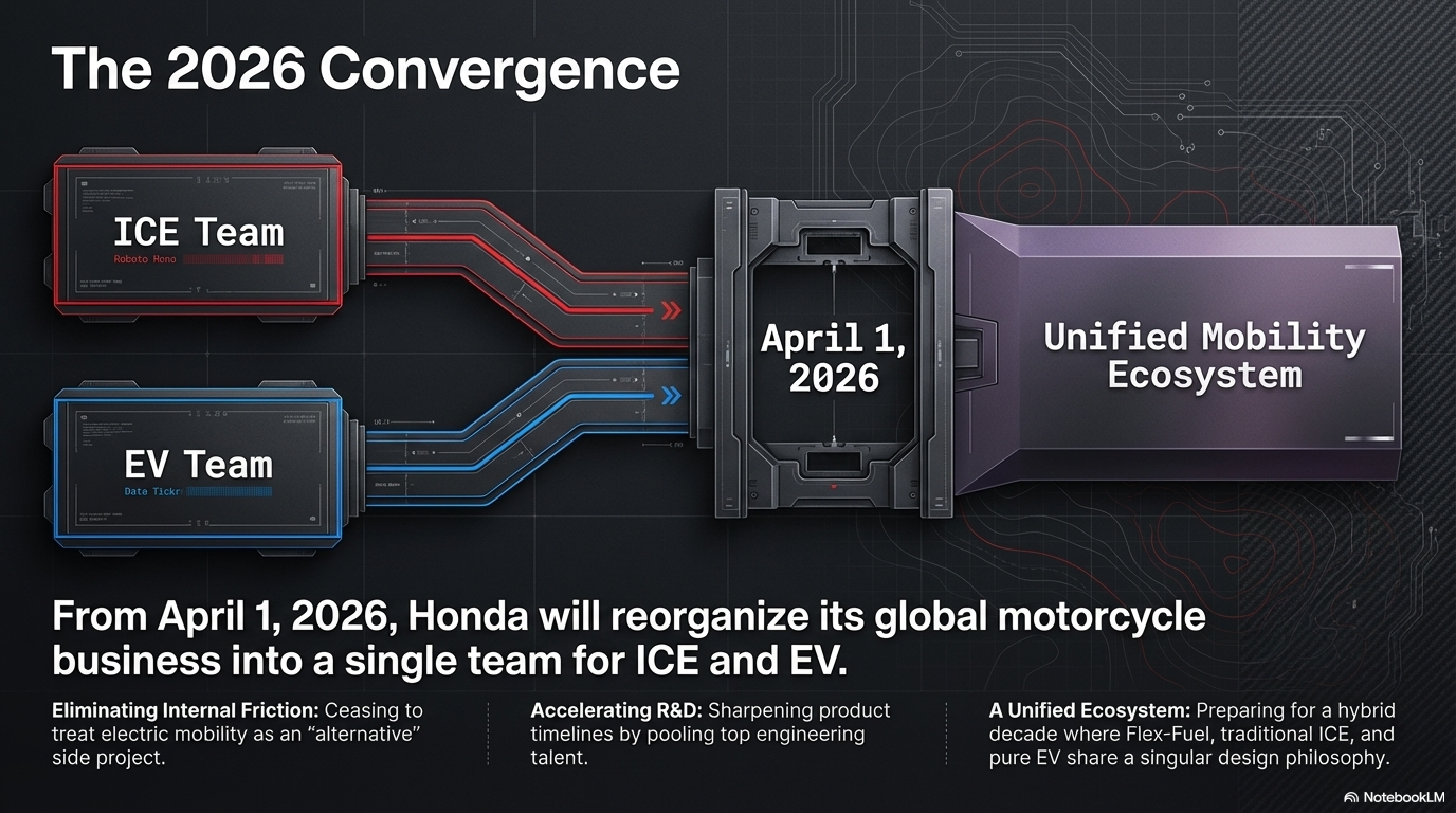
In a move that stands in sharp contrast to every rival's playbook, Honda is merging its internal petrol (ICE) and electric (EV) motorcycle divisions into a single unified global team, effective April 1, 2026.
Compare this to the approach of competitors. Hero MotoCorp has spun off its EV operations into a separate "Vida" brand, designed to attract venture capital and move like a nimble startup. Ola Electric operates as an entirely independent entity. Even Bajaj treats its Chetak EV division with relative operational independence.
Why This Matters?
By integrating ICE and EV teams, Honda is making a bold statement: electric vehicles are not a separate experiment they are Honda's core business. The goal is to bake the engineering DNA of its petrol legends directly into its electric future, eliminating internal friction from day one.
This also has a practical implication for Indian buyers. A unified engineering team means Honda's legendary reliability, its 60-million-vehicle quality culture, and its service network will be the same team responsible for your next electric Honda. That is a promise no EV-only startup can currently match.
The E-Clutch Arrives:
Honda Transalp XL750 Gets Smarter
Honda's final 2026 masterstroke is aimed squarely at India's rapidly growing adventure motorcycle community. The Honda Transalp XL750 is set to receive Honda's innovative E-Clutch system and it changes the adventure riding equation completely.
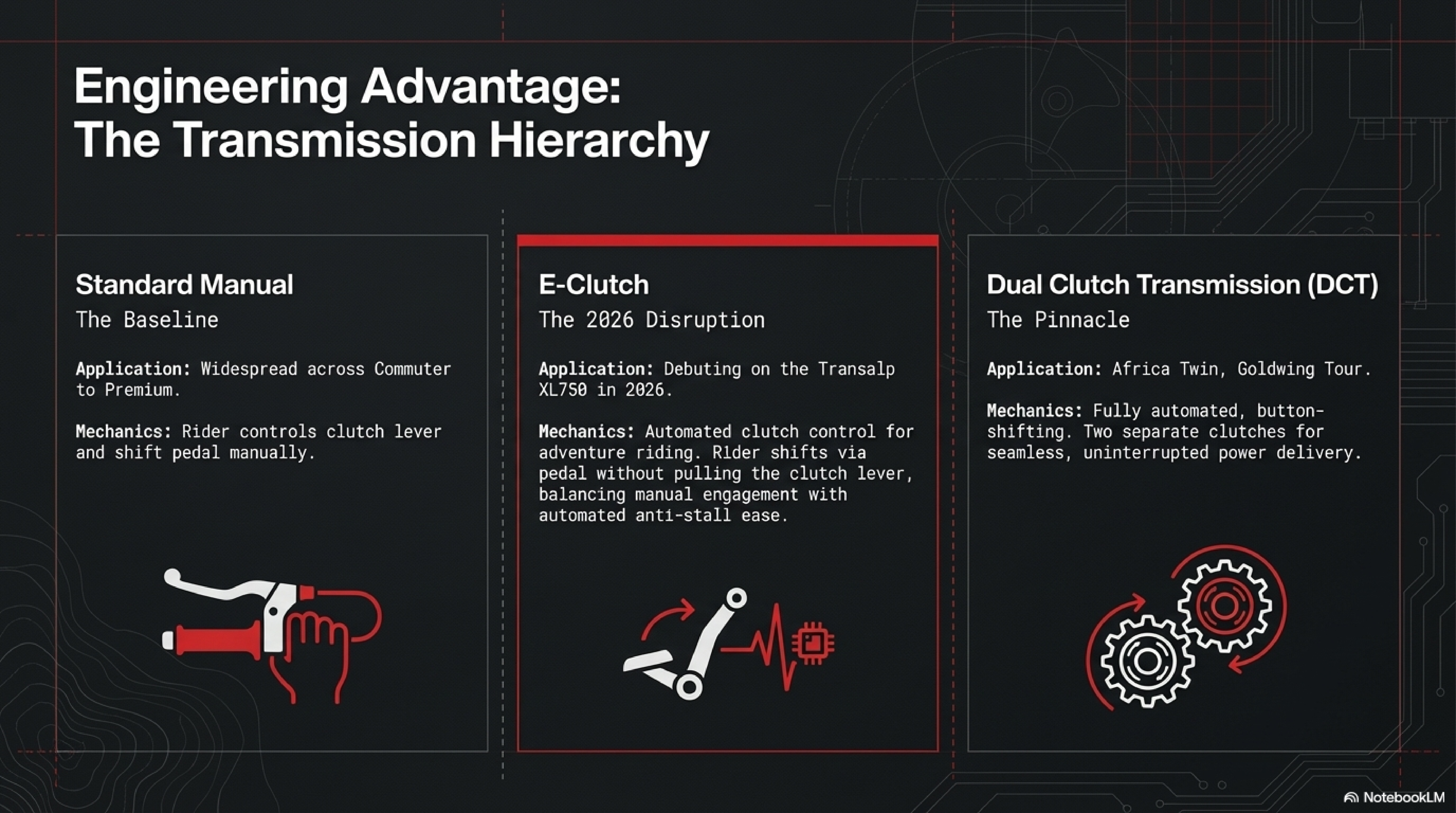
Unlike the heavy Dual Clutch Transmission (DCT) found on the Africa Twin, the E-Clutch is a lightweight automated clutch mechanism. It provides clutch-free operation in stop-and-go city traffic while preserving the full tactile feel and engagement of a manual gearbox on the open road or off-road trail.
New Feature: Honda E-Clutch SystemBenefitNo stalling in city stop-and-goAdvantage over DCTLighter, retains manual feelKey RivalsSuzuki V-Strom 800 DE, KTM 890
AdventureIndia Availability2026 (Expected)
For Mumbai's notorious stop-and-go traffic, the E-Clutch means no more embarrassing stalls at signals. For Ladakh's high-altitude trails, it means you can still feel every gear change through your hands. This dual capability, city-smooth and trail-connected is why the Transalp E-Clutch is a direct shot at rivals like the Suzuki V-Strom 800 DE that simply don't offer this balance.
It also demonstrates Honda's broader strategy: flagship technology, typically reserved for large-displacement, expensive motorcycles is now being democratised to the popular middleweight segment. This is Honda out-innovating the competition, not just out-selling them.
Frequently Asked Questions:
Q1: What is the price of the Honda Activa e: in India in 2026?+
Ans: The Honda Activa e: is priced at ₹1,19,445 (ex-showroom). It delivers an 80 kmph top speed and a 102 km IDC claimed range, powered by two swappable 1.5 kWh batteries. Honda is also developing a new, more affordable and locally produced electric scooter on the J1H platform, expected by end-2026.
Q2: What is Honda's E-Clutch and which bikes in India will get it?+
Ans: Honda's E-Clutch is a lightweight automated clutch system that allows clutch-free riding without removing the tactile feel of a manual gearbox. By 2026, the Honda Transalp XL750 adventure motorcycle is expected to receive this system in India, making it one of the most tech-forward adventure bikes in the segment.
Q3: Is Honda merging its petrol and electric motorcycle teams in 2026?+
Ans: Yes. Effective April 1, 2026, Honda globally merges its ICE and EV motorcycle divisions into one unified team. This signals that Honda views electric vehicles as its core business, not a separate experiment and that its legendary reliability culture will be applied to future EVs from day one.
Q4: What is the cheapest and most expensive Honda two-wheeler in India in 2026?+
Ans: Honda's most affordable two-wheeler is the Shine 100 at ₹65,557 (ex-showroom). At the premium end, the Gold Wing Tour at ₹43,12,654 (ex-showroom) sits at the top, featuring a 1,833cc flat-six engine, 124.7 bhp, and sold exclusively through Honda's BigWing premium dealerships.
Q5: How many vehicles has Honda sold in India cumulatively?+
Ans: Honda Motorcycle and Scooter India (HMSI) has surpassed 60 million cumulative vehicles sold in India. This milestone is backed by four manufacturing plants — Manesar, Narsapura, Tapukara, and Vithalapur — giving Honda a production capacity being expanded to 2.01 million units annually at Tapukara alone.
Q6: How does the Honda Activa e: compare to TVS iQube and Bajaj Chetak?+
Ans: The Activa e: uses a unique battery-swap model, which limits usability near Honda's swap network. The TVS iQube and Bajaj Chetak both offer home-charging convenience, better boot space, and have accumulated more market acceptance. Honda's upcoming J1H-platform scooter is specifically engineered to close this gap with higher localisation and comparable range.
The Road Ahead for Honda India
Honda is no longer simply the curator of the reliable 125cc commuter. With the Tapukara factory expanding to 2.01 million unit annual capacity, a unified ICE-EV engineering team, a tiered electric portfolio, flex-fuel mid-range bikes, and E-Clutch adventure machines: HMSI is building the infrastructure for a decade of dominance.
The infrastructure is ready. The teams are merging. The electric lineup is evolving. But one question lingers for every Indian rider: in a world of rapidly evolving electric tech and luxury cruisers, will the classic, reliable commuter still be the heartbeat of the Indian garage by 2030?
Quick Facts:
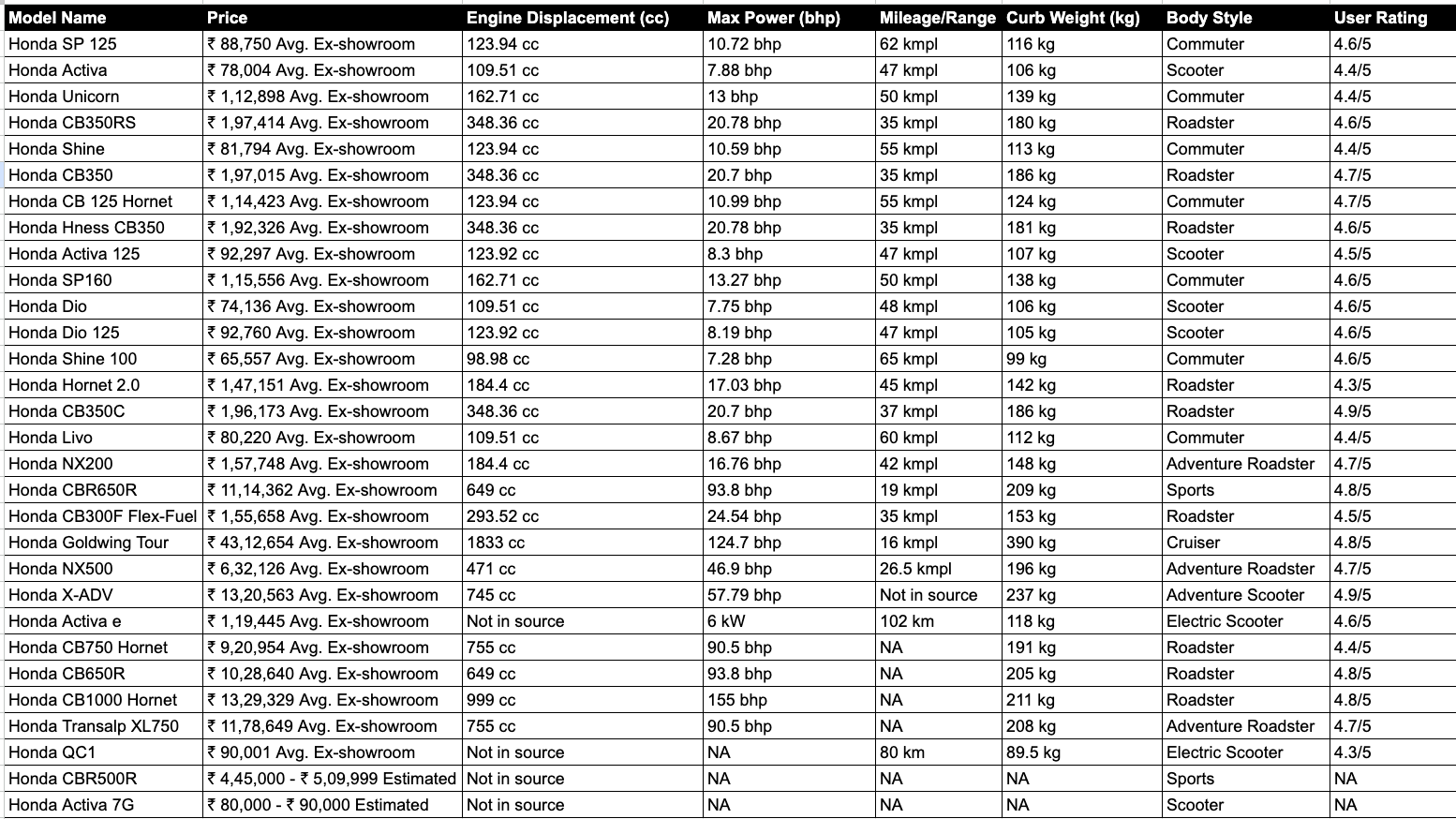
Honda Shine 100: Price ₹ 65,557, Engine 98.98 cc, Power 7.28 bhp, Mileage 65 kmpl, Weight 99 kg, Body Style Commuter, Rating 4.2/5
Honda Activa: Price ₹ 78,004, Engine 109.51 cc, Power 7.73 bhp, Mileage 48 kmpl, Weight 105 kg, Body Style Scooter, Rating 4.2/5
Honda SP 125: Price ₹ 88,750, Engine 123.94 cc, Power 10.72 bhp, Mileage 65 kmpl, Weight 116 kg, Body Style Commuter, Rating 4.3/5
Honda Dio: Price ₹ 74,136, Engine 109.51 cc, Power 7.75 bhp, Mileage 48 kmpl, Weight 103 kg, Body Style Scooter, Rating 4.2/5
Honda Shine: Price ₹ 83,431, Engine 123.94 cc, Power 10.59 bhp, Mileage 55 kmpl, Weight 113 kg, Body Style Commuter, Rating 4.2/5
Honda Activa 125: Price ₹ 84,334, Engine 124 cc, Power 8.19 bhp, Mileage 46 kmpl, Weight 109 kg, Body Style Scooter, Rating 4.3/5
Honda Unicorn: Price ₹ 1,12,898, Engine 162.71 cc, Power 12.73 bhp, Mileage 50 kmpl, Weight 139 kg, Body Style Commuter, Rating 4.3/5
Honda SP 160: Price ₹ 1,22,118, Engine 162.71 cc, Power 13.27 bhp, Mileage 45 kmpl, Weight 139 kg, Body Style Commuter, Rating 4.3/5
Honda CB350: Price ₹ 1,97,015, Engine 348.36 cc, Power 20.78 bhp, Mileage 35 kmpl, Weight 187 kg, Body Style Roadster, Rating 4.6/5
Honda CB350RS: Price ₹ 2,13,004, Engine 348.36 cc, Power 20.78 bhp, Mileage 35 kmpl, Weight 179 kg, Body Style Roadster, Rating 4.7/5
Honda Hness CB350: Price ₹ 2,07,678, Engine 348.36 cc, Power 20.78 bhp, Mileage 35 kmpl, Weight 181 kg, Body Style Roadster, Rating 4.7/5
Honda Hornet 2.0: Price ₹ 1,41,833, Engine 184.4 cc, Power 17.03 bhp, Mileage 40 kmpl, Weight 142 kg, Body Style Roadster, Rating 4.3/5
Honda Dio 125: Price ₹ 88,348, Engine 123.92 cc, Power 8.16 bhp, Mileage 48 kmpl, Weight 104 kg, Body Style Scooter, Rating 4.4/5
Honda Activa e: Price ₹ 1,19,445, Engine N/A, Power N/A, Mileage 102 km/charge, Weight 118 kg, Body Style Electric Scooter, Rating 4.1/5
Honda NX500: Price ₹ 5,90,323, Engine 471 cc, Power 46.9 bhp, Mileage 27.8 kmpl, Weight 196 kg, Body Style Adventure, Rating 4.5/5
Honda CB300R: Price ₹ 2,41,757, Engine 286.01 cc, Power 30.7 bhp, Mileage 30 kmpl, Weight 146 kg, Body Style Roadster, Rating 4.4/5
Honda XL750 Transalp: Price ₹ 10,99,990, Engine 755 cc, Power 90.5 bhp, Mileage 23 kmpl, Weight 208 kg, Body Style Adventure, Rating 4.8/5
Honda CBR650R: Price ₹ 11,14,362, Engine 648.72 cc, Power 85.82 bhp, Mileage 20 kmpl, Weight 211 kg, Body Style Sports, Rating 4.7/5
Honda Goldwing Tour: Price ₹ 43,12,654, Engine 1833 cc, Power 124.7 bhp, Mileage 14 kmpl, Weight 390 kg, Body Style Cruiser, Rating 4.9/5
Honda CB1000 Hornet: Price ₹ 13,29,329, Engine 999 cc, Power 149.6 bhp, Mileage 16 kmpl, Weight 214 kg, Body Style Roadster, Rating 4.6/5
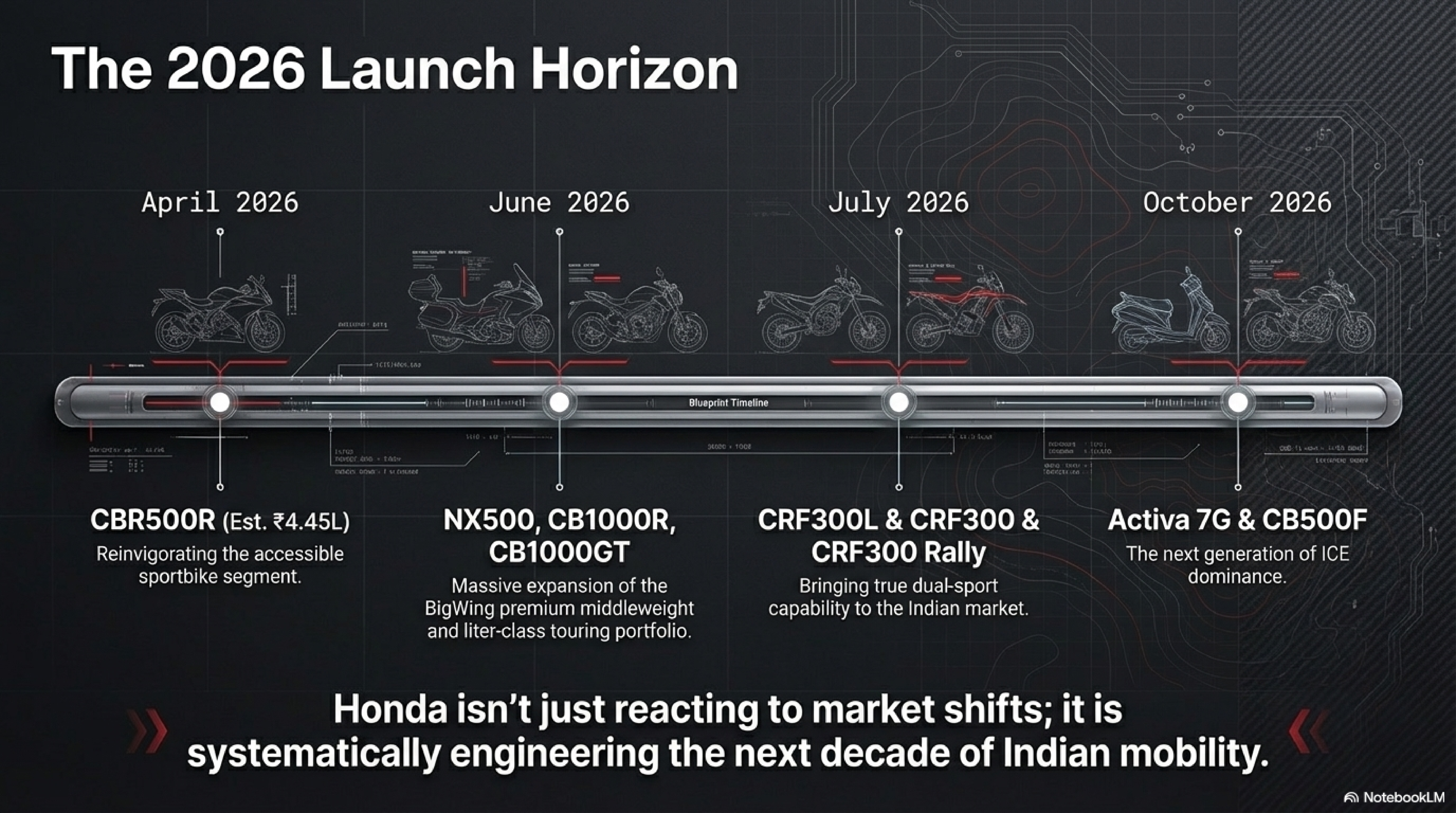
Honda Activa 7G: Price ₹ 80,000 - 90,000 (Estimated), Engine 109.51 cc (Expected), Power 7.73 bhp (Expected), Mileage 50 kmpl (Expected), Weight 106 kg (Expected), Body Style Scooter (Upcoming), Rating N/A
Activa e: Price: ₹1,19,445 ex-showroom
Activa e: Range: 102 km (IDC)
Gold Wing Price: ₹43,12,654
Shine 100 Price: ₹65,557
Plants: Manesar, Narsapura, Tapukara, Vithalapur
ICE+EV Merger: April 1, 2026
E-Clutch Bike: Transalp XL750
Flex-Fuel: CB300F at ₹1,55,658
Top SEO Keywords (2026)
🔍Honda Activa Electric price 2026
🔍Honda Activa e: vs QC1
🔍Best electric scooter India 2026
🔍Honda E-Clutch India launch
🔍Honda Transalp XL750 2026
🔍HMSI 2026 roadmap news
🔍Honda Gold Wing Tour India price
Like this article? Share it with your friends


