


Ask Disha Took 150,000 Calls Yesterday via AI implementation
How a Bengaluru startup quietly became the AI backbone of Indian government service and why nobody in Silicon Valley saw it coming.
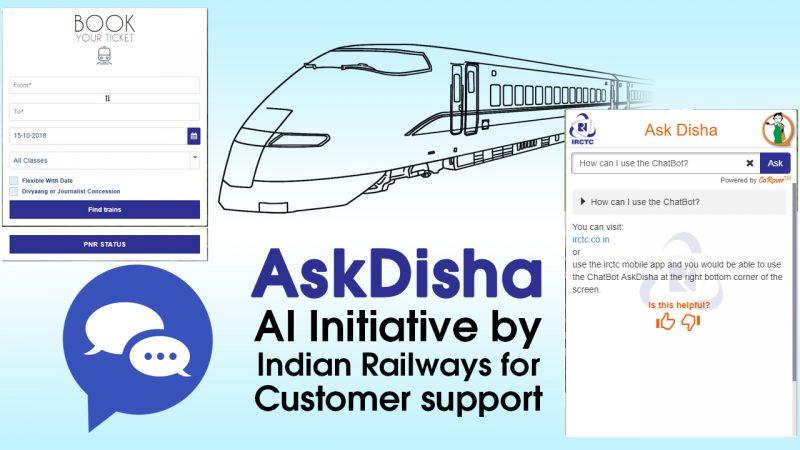
India's busiest AI is not inside a bank, a startup, or a Big Tech lab. It lives inside a railway booking portal — answering 150,000 queries every single day, in 12 languages, without a single human operator on the line. The company behind it has been building quietly since 2016.
It is 6:14 AM on a Tuesday in Patna. Ranjeet Singh is trying to book a ticket for his mother's surgery in Delhi. He doesn't speak English. The IRCTC website confuses him. He types in Hindi, haltingly: "mere pass Aadhar se kya hoga?" Within two seconds, Ask Disha responds — correctly, in Hindi, explaining the ID verification process step by step. Ranjeet books the ticket. CoRover.ai just handled its 42,000th query of the morning.
Most people who've used Ask Disha don't know who made it. That's somewhat by design. CoRover.ai, founded by Ankush Sabharwal in Bengaluru in 2016, doesn't spend much on marketing. What it spends on is accuracy — 90% query resolution without human intervention, across a platform that has become the de facto conversational interface for Indian Railways' 8 billion annual passengers.
This is not a chatbot story. It's an infrastructure story.
The Bet That Most AI Companies Got Wrong
In 2016, when CoRover began building, the dominant assumption in the chatbot industry was that the money was in consumer apps — personal assistants, shopping bots, social messaging integrations. The enterprise market seemed too slow, too procurement-heavy, too politically complicated.
Sabharwal made the opposite bet. He focused almost exclusively on large institutional clients: railways, banks, public sector enterprises. The thesis was simple but unfashionable — the organizations that had the most customer queries, the least service bandwidth, and the worst digital UX were government bodies. The TAM wasn't a consumer niche. It was the entire Indian state.
"The hardest customer to win is a government agency. The most durable customer is also a government agency. CoRover figured this out before anyone else did."
Ask Disha went live with IRCTC in 2018. Within 18 months it was handling 70,000 daily queries. Today that number has more than doubled. In the process, CoRover has built a playbook that most conversational AI companies never manage: a deep integration with backend systems, multilingual NLP fine-tuned on Indian language patterns, and the operational trust of the world's fourth-largest railway network.
150K
Daily Queries
90%
Resolution Accuracy
70+
Chatbots Deployed
12
Languages Supported
The Moat: What CoRover Actually Sells
Ask a CoRover client what they're buying and they'll say "a chatbot." Ask CoRover what they're selling and the answer is more interesting: a conversational data layer. Every query through Ask Disha generates structured intent data — what passengers are confused about, where the booking funnel breaks, which language cohorts have different need patterns. This data feeds model improvement, which feeds accuracy, which feeds contract renewal. The flywheel is real.
The company has built 70+ chatbots across sectors — banking (50+ clients), insurance, healthcare, e-commerce, education. Clients include Microsoft, Google, Flipkart, and a roster of public sector banks. The common thread isn't the industry — it's scale. CoRover doesn't work well for a 10-person startup. It works extremely well for an organization fielding 10,000 customer queries a day.
The GPT Disruption Question
Every conversational AI company faces the same question today: doesn't ChatGPT just make you irrelevant? It's a reasonable concern, and CoRover's answer is nuanced. General-purpose LLMs are powerful, but deploying one inside IRCTC's booking infrastructure isn't a weekend project. It requires railway-specific training data, integration with PNR APIs, multilingual disambiguation for names like "Patna" (which can be spelled 23 ways in transliteration), and — critically — IRCTC's trust.
CoRover's edge isn't the model. It's the deployment. They've earned something that takes years to accumulate: an institutional relationship with India's most demanding public-sector clients. A startup with better NLP cannot simply walk in and replace them. The switching cost is enormous — not technical, but organizational.
That said, CoRover is not resting. The company has integrated LLM capabilities into its platform, positioning itself as an AI orchestration layer rather than a pure-play NLP provider. The framing matters: they're not competing with GPT-4, they're using it.
The Business Model, Plainly
CoRover operates on a B2B SaaS model — primarily annual contracts with large enterprises and government bodies. Revenue scales with query volume and the number of integrations. The IRCTC contract, while not disclosed publicly, is understood to be a landmark anchor reference that opens doors to every railway body, airport authority, and public transport network in India and potentially beyond.
The company has raised undisclosed rounds and remains founder-led. Sabharwal has been explicit about the international ambition — Southeast Asia and the Middle East are on the roadmap, where similar large-scale public service digitization is underway. The playbook translates: find the highest-volume, lowest-satisfaction government interface, and replace it with something that actually works.
Risk Factors to Watch
LLM commoditization: As foundation models improve and become cheaper, the barrier to entry in conversational AI lowers. CoRover's moat is data + relationships, not model architecture — but this needs active defense.
Government contract concentration: A significant portion of revenue likely depends on a handful of large contracts. IRCTC renewal risk, though low, is non-zero. Political shifts can delay procurement cycles.
Talent drain: Bengaluru's AI talent market is ferocious. Retaining NLP engineers who can be hired by Google or Anthropic at 3x salary requires equity structures and mission alignment.
Hallucination risk at scale: At 150K daily queries, even a 1% error rate means 1,500 wrong answers per day. In a railway booking context, wrong answers can cause real harm — missed trains, wrong stations, frustrated passengers.
What the Industry Gets Wrong About CoRover
Most startup press coverage of CoRover frames it as "India's ChatGPT for government." This misses the point entirely. CoRover is not trying to be a general-purpose AI. It is trying to be the invisible infrastructure that makes large Indian institutions capable of talking to their own customers. The analogy isn't ChatGPT — it's Twilio.
Twilio didn't invent SMS. It made SMS programmable for businesses. CoRover didn't invent chatbots. It made conversational AI deployable for organizations that had no way to build it themselves — in Indian languages, at Indian scale, within Indian regulatory constraints. That's a different product category, a different sales motion, and a different moat.
The company's next act — integrating video and voice into its conversational stack — is an interesting signal. India has 700 million smartphone users but enormous variation in digital literacy. Voice and video interfaces aren't premium features; in many segments of the Indian market, they're accessibility requirements. If CoRover can build the WhatsApp Business API of government services, the opportunity is genuinely large.
Frequently Asked Questions
What is CoRover.ai and what does it actually do?
CoRover.ai is a Bengaluru-based enterprise conversational AI company founded in 2016. Its most visible product is Ask Disha, the AI assistant deployed on IRCTC's railway booking platform — India's largest e-commerce website by transaction volume. It handles 150,000 daily queries across 12 Indian languages with 90% accuracy.
How is CoRover different from other chatbot companies?
Most chatbot SaaS companies sell tools. CoRover sells outcomes — specifically, the ability to handle massive query volumes in Indian languages without human intervention. Its differentiation lies in seven years of proprietary training data from real Indian users, deep backend integrations with government systems, and institutional trust from deployments at organizations like IRCTC, 50+ banks, and major insurers.
Will AI models like ChatGPT make CoRover obsolete?
Unlikely in the near term. CoRover's moat isn't the underlying model — it's the deployment layer, the institutional relationships, and the India-specific training corpus. The company is actively integrating LLM capabilities to stay current. Its biggest risk from AI models is margin compression (if inference costs drop and commoditize the space) rather than direct replacement.
What sectors does CoRover serve beyond railways?
Banking (50+ institutions), insurance, healthcare, e-commerce, and education. Clients include Microsoft, Google, and Flipkart. The common pattern is high query volume, multilingual user bases, and complex backend integrations — not consumer-facing startups, but large enterprises that need industrial-grade conversational infrastructure.
The Verdict
CoRover.ai is one of the most quietly consequential AI companies India has produced. It solved a genuinely hard problem — building a conversational layer for institutions with 100M+ users, in 12 languages, at production reliability — and it did so without much fanfare or venture capital noise.
The risk is staying relevant as LLMs reshape what's possible. The opportunity is becoming the standard conversational infrastructure for every large public-sector organization in India and eventually Southeast Asia. The Twilio analogy is apt: the best infrastructure companies don't get famous. They get embedded.
Watch for: International expansion to Southeast Asia, a voice/video layer rollout, and eventually whether a larger platform (Infosys, TCS, or a global hyperscaler) decides this is worth acquiring.
Sources & References
IRCTC Ask Disha deployment data · CoRover.ai official website and press releases · Crunchbase company profile · LinkedIn company page · TechCrunch India coverage · NASSCOM GovTech reports · Primary research, March 2025.
This article is an independent editorial analysis. Analog Ventures Research has no commercial relationship with CoRover.ai.
For more important updates and curated information on regular basis, Join our whatsapp community : https://chat.whatsapp.com/DfkQi7r4o4dDduWvYor9dk
Like this article? Share it with your friends


